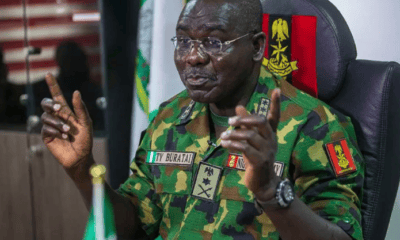
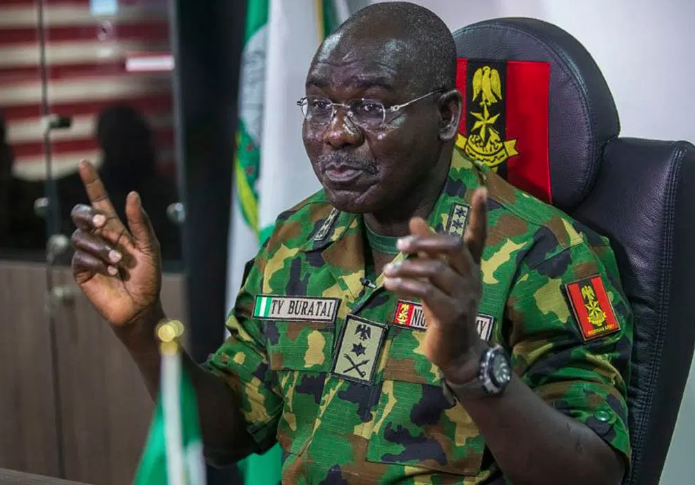
Former Chief of Army Staff, COAS, Lt. Gen Yusuf Buratai, retd., disclosed yesterday that the $1bn approved for defence procurement during his tenure as Army Chief by the federal government was released to the Ministry of Defence and not the services.
Gen Buratai disclosed that the funds, which were approved by the National Economic Council, NEC, did not pass through his hands or the accounts of the Nigerian Army, Navy and Air Force.
He said allegations surrounding the funds turned out to be “political and malicious,” noting that “they first emerged during the 2019 election period when the opposition alleged that the money had been diverted for electoral purposes”
His words: The $1 billion was approved by the National Economic Council, NEC, for defence procurement. Not a single dollar of that fund passed through my hands or through the accounts of the Nigerian Army, Navy, or Air Force.
“The funds were released to the Ministry of Defence, and the entire procurement process was handled by that ministry. The Army, Navy, and Air Force never had a single dollar from that fund to make procurement directives.
“I have described these allegations as political and malicious. They first surfaced during the 2019 election period when the opposition alleged the funds had been diverted for electoral purposes, a claim the federal government publicly refuted. Yet the stain remained, attached to the service chiefs, rather than the institution that managed the funds.”
The former COAS said the federal government publicly refuted the allegation at the time but lamented that the controversy continued to affect the reputation of service chiefs.
He faulted the ministry for not publicly explaining how the funds were disbursed or how contracts were awarded.
“The ministry, since then on its own, had not publicly explained how the funds were disbursed or contracts awarded. Accountability must be properly located,”he said.
While calling for greater transparency in military procurement, Buratai recommended the establishment of a defence procurement transparency portal to publish information on contracts awarded, contracting entities and delivery timelines, subject to national security considerations.
“The Ministry of Defence must own procurement record. The $1 billion arms procurement controversy festered because the institution that managed the funds, the Ministry of Defence, remained silent while service chiefs absorbed criticism.
“I recommend a Defence Procurement Transparency Portal that publishes, within national security limits, broad categories of contracts awarded, contracting entities, and delivery timelines.
“When the media asks where the money went, the answer should come from the ministry that spent it, not from military officers who never touched it,” he said.
Furthermore, Buratai proposed quarterly accountability bulletins summarising court martial outcomes relating to human rights violations and operational conduct, provided the publications did not compromise the rights of accused personnel or ongoing military operations.
Speaking on alleged human rights violations by members of the Nigerian security forces, Buratai said credible claims should be investigated and, where substantiated, prosecuted.
“I have always maintained that where credible allegations exist, they must be investigated and, where substantiated, prosecuted. The military is not above the law,” he said.
He acknowledged the need for the military to demonstrate that its disciplinary processes were credible, transparent and capable of addressing allegations at all levels.
He said that improved communication by the military and the Ministry of Defence would help address public concerns and ensure that media reports reflected the full context of security operations.
In his remarks, Former Senate President and Chairman Senate Committee on Defence Senator Ahmed Lawan, called for a dedicated percentage of Nigeria’s revenue to funding of the Armed Forces of Nigeria and other security agencies to procure more platforms.
He noted that the National Assembly had been supporting the Armed forces and other security agencies by way of budgetary approvals.
He said: “For us in the National Assembly, it is our duty to support the arm of government, to ensure that whatever resources are available and are required, are requested by the arm of government, we support that and we even give more.
‘’As at today, I am over 27 years as a member of the National Assembly, I have not seen any request sent by the executive for the armed forces and other security agencies that has not been approved. In fact, in most cases, they were always approved because we believe that security is first.’’
The Minister of Defence, General Christopher Musa, in his remarks, said: ‘Today’s security threats are increasingly complex, adaptive and interconnected. Terrorist groups, criminal networks and other adversaries exploit information, technology, financial systems and gaps in coordination to pursue their objectives.
Represented by Air Commodore Steven Ogunmodede, retd., Senior Special Assistant on Foreign Relations, the minister said: “Consequently, our response must combine effective combat operations with timely intelligence, technological capability, sound planning and cooperation among relevant security institutions.
“This is the essence of intelligence-led operations. The ability to identify a threat early, understand its networks, anticipate its intentions and act with precision can make the difference between preventing an attack and responding after lives have been lost.
“Technology can strengthen our surveillance, reconnaissance, communications and analytical capabilities, but it must be supported by trained personnel, reliable systems, effective doctrine and sound operational judgement.
“Technology is a force multiplier, it does not replace the human judgement, discipline and professional competence upon which military effectiveness ultimately depends.
“At the Ministry of Defence and across the Armed Forces of Nigeria, we recognise the importance of these capabilities and continue to pursue approaches that improve situational awareness, intelligence coordination and operational effectiveness.
“We must remain willing to learn, adapt and innovate, while ensuring that investments in technology translate into practical improvements in our ability to protect lives, defend our territorial integrity and respond to emerging threats.
“Equally important is the need to strengthen cooperation across our security architecture, because no single institution possesses all the information or capabilities required to address today’s security challenges.’’