
Politics
Tinubu/Shettima: North Central APC Forum rejects Lalong’s appointment, says it’s an insult

Leaders and members of the All Progressives Congress (APC) under the aegis of the North Central APC Forum have called on Governor Simon Bako Lalong to immediately reject his appointment as the Director-General of the Tinubu/Shettima Presidential Campaign Organization.
They described it as an insult to the region and a slap on the face of her people.

The Forum said it had been canvassing for the emergence of the next President from the zone.

Speaking on behalf of the Forum in Jos, the Plateau State Capital, Saleh Mandung Zazzaga explained that their initial stance was not to compromise the 2023 Presidency for any other position, because apart from the military era, the region had not produced either the president or the Vice President.

Zazzaga noted that it then became obvious that their push for the presidency could not be actualized since the APC, in a way of mutual understanding, considered the Southern part of the country for the presidency.
He said that they immediately began to canvass for the Vice Presidential slot, which eventually went to the North East.
According to him, “If the North Central is not good or qualified enough for the presidential ticket because the party thinks nobody from the region has the political weight to pull votes from the Northern region come 2023, how come then has the party or presidential candidate in the person of Tinubu become so trustful of someone from the region to become the presidential campaign organization Director-General?
“Our concern in the 2023 elections is either the President or Vice President, but we were denied because they considered us either not qualified or competent enough. But as soon as it came to Director-General of the presidential campaign, we suddenly became the most qualified.
“Ironically, it is the same Governor Simon Bako Lalong whom we have been canvassing support for as either President and then later as a presidential running mate/vice president, that was suddenly appointed as the Director-General of the party’s presidential campaign organization. We spent lots of resources pushing for either the presidential slot or vice president at different times and it was all over the media since last year.”
“We, therefore, consider Lalong’s appointment as insulting, degrading and making the region irrelevant in the political calculation of the country. We won’t accept this because this is quite unfair and sort of relegating our people to the background.
“That is why we are calling on Governor Lalong to reject this offer, and those celebrating his selection from the region should desist henceforth because this is a great slap on our face.
“We have been pushing for the good of the region in national political affairs all along, but those who have never lent their voices, time and resources to our cause are busy celebrating the ‘relegation’ of our region in this 2023 elections at the national level. This is quite insensitive, unfortunate and regrettable,” he said.


Politics
Yilwatda Presents APC Flags, Symbolic Brooms to South-East Governorship Candidates, Charges Them to Sweep 2027 Polls
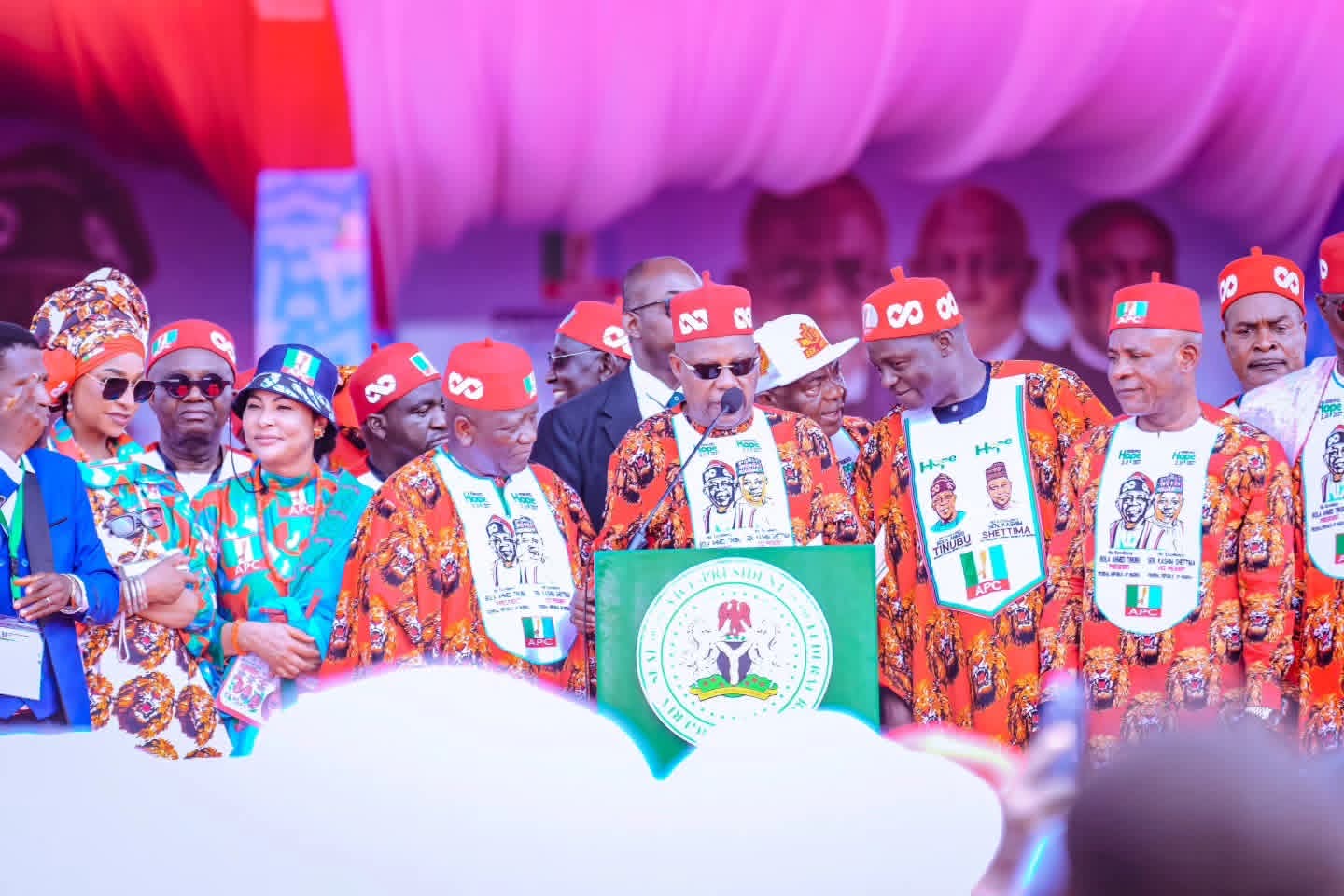
The National Chairman of the All Progressives Congress (APC), Professor Nentawe Goshwe Yilwatda, has presented the party’s flags and symbolic brooms to its governorship candidates in Enugu, Abia and Ebonyi states ahead of the 2027 general elections, charging them to mobilise massive support and secure victory at the polls.
The candidates are Governor Peter Mbah of Enugu State, Chief Eric Chinemuecheya Opah of Abia State and Governor Francis Ogbonna Nwifuru of Ebonyi State.
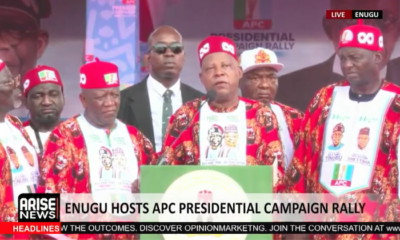
The presentation took place on Friday during the APC presidential campaign rally in Enugu, attended by President Bola Tinubu, Vice President Kashim Shettima, governors, members of the party’s National Working Committee (NWC), elected officials and other party stakeholders.
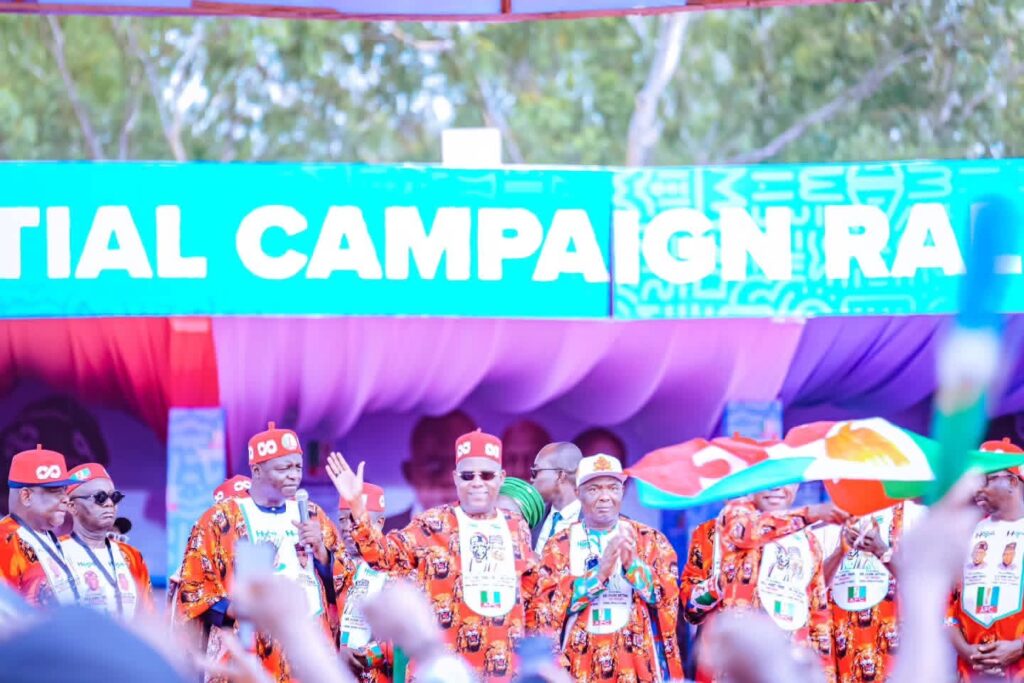
The party flags and symbolic brooms were presented to the candidates through Vice President Shettima, with Yilwatda describing the gesture as a demonstration of the APC’s confidence in its candidates and determination to consolidate its political strength across the South-East.
In a statement issued by his Special Adviser on Media and Information Strategy, Abimbola Tooki, the APC chairman urged the candidates to fly the party’s flag proudly, take its message to every community and constituency, and mobilise voters for overwhelming victories in 2027.
Yilwatda gave a special charge to Governor Nwifuru, urging him to fly the APC flag high and ensure that Ebonyi State delivers an overwhelming number of votes for the ruling party.
He similarly charged the Abia governorship candidate, Opah, to strengthen the party’s grassroots structures, expand its support base and mobilise voters towards victory in the state’s governorship election.
Using the broom, which is the APC’s official electoral symbol, as a metaphor for electoral success, Yilwatda urged the candidates to maximise every political opportunity and ensure that the party sweeps votes across their respective states.
He said the broom represents the party’s identity, unity, collective strength and political organisation, stressing that victory in the forthcoming elections would require coordinated efforts by candidates, party leaders and grassroots supporters.
The APC national chairman also called on party members and supporters in the three states to close ranks, strengthen the party’s structures and demonstrate commitment to the electoral success of its candidates.
He emphasised that the responsibility of winning elections should not be left to the candidates alone, noting that every party member had a role to play in expanding the APC’s support base and communicating the achievements and vision of the Tinubu administration.
Yilwatda further highlighted President Tinubu’s leadership and the collective responsibility of party stakeholders in consolidating the APC’s political position and advancing the administration’s Renewed Hope Agenda.
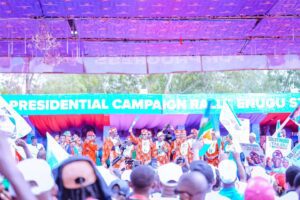
The Enugu rally provided an opportunity for the ruling party to demonstrate its organisational strength and mobilise its South-East structures ahead of the 2027 general elections.
The presentation of the flags and symbolic brooms, according to the statement, reaffirmed the party leadership’s confidence in its candidates and determination to secure electoral victories across the region.
…Says Ndigbo Deserve Eight Years When It Is Their Turn
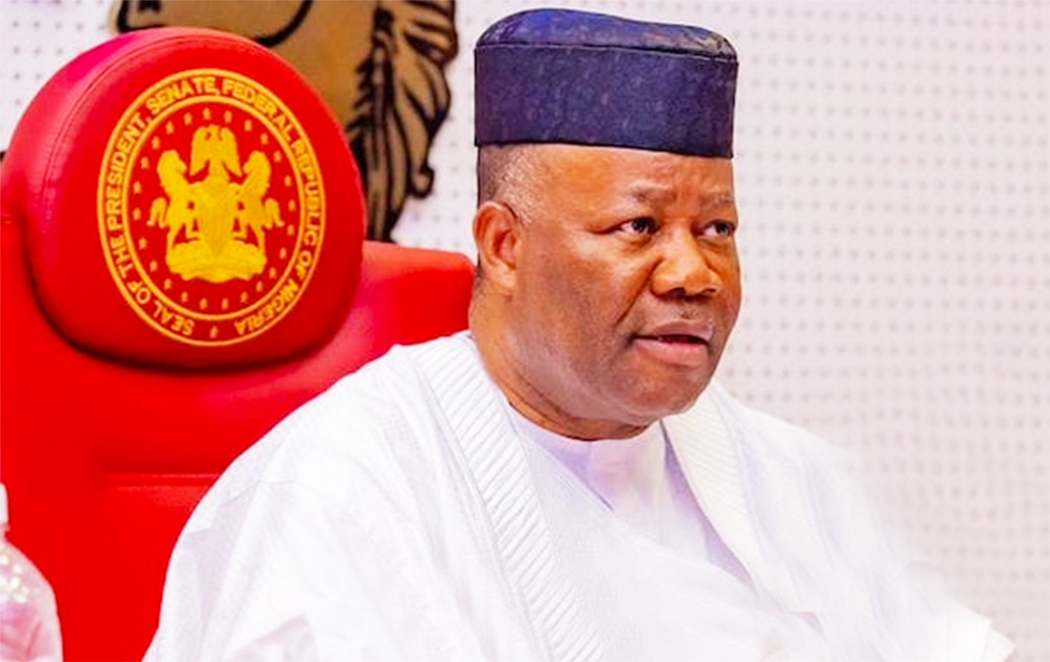
Senate President Godswill Akpabio has urged the people of the South-East to reject any presidential candidate offering a one-term, four-year presidency, insisting that the region deserves the opportunity to complete two constitutionally guaranteed terms when it produces Nigeria’s president.
Akpabio made the appeal on Saturday at the flag-off of the All Progressives Congress (APC) presidential campaign rally at Michael Okpara Square, Enugu, where he urged Ndigbo to support President Bola Tinubu’s re-election bid in 2027.
His remarks were contained in a statement issued in Abuja by his media aide, Jackson Udom.
The Senate President cautioned the South-East against accepting what he described as a political arrangement capable of shortchanging the region, arguing that its people should not sacrifice their long-term political interests for a four-year presidential deal.
He maintained that Nigerians would support the South-East to complete eight years in office when it becomes the region’s turn to produce the President.
Akpabio’s comments come amid growing political debate over presidential zoning, regional power rotation and calls for an arrangement that would guarantee the South-East an opportunity to occupy the nation’s highest political office.
He said the people of the region, like other geopolitical zones, deserved the opportunity to serve two presidential terms when their turn came.
“I am happy to tell you today that I am very happy with the turnaround of Ndigbo.
“I want to tell you today that if anybody comes around to tell you that he has made an arrangement somewhere and that he is going to do four years as President and shortchange Ndigbo, such a person should be rejected.
“When it is the turn of Ndigbo, Nigerians will support Ndigbo to do eight years. This is your time to prove the political collaboration that your leaders have talked about. Do not agree for anybody to tell you that you should do four years,” he said.
Akpabio urged the people of the South-East to vote massively for Tinubu and other APC candidates, describing support for the ruling party as an opportunity for the region to demonstrate its commitment to political collaboration with other parts of the country.
“I implore you to vote massively for President Bola Tinubu who has shown love to Ndigbo. I implore you to also give massive votes to all other candidates of the APC. You will show clearly that you are ready to collaborate with other regions,” he added.
Former Anambra State Governor and presidential candidate of the Nigeria Democratic Congress (NDC), Peter Obi, has repeatedly pledged to serve only one four-year term if elected President in 2027, ruling out a second term in office.
Akpabio, however, described the people of the South-East as intelligent, resourceful and politically significant, urging them to strengthen their political engagement with other regions.
Defending the Tinubu administration, the Senate President said the President had recorded achievements in infrastructure development, education, fiscal reforms and political stability.
“President Bola Tinubu has not only built infrastructure, he has not only built the educational sector, he has not only reformed the finances of Nigeria to make money available to the States to build infrastructure, he has stabilised the polity.
“Do not allow somebody who fly from one political party to another to mislead you. When it is your turn, you will do eight years,” he said.
Meanwhile, Tinubu, in his address at the rally, promised additional infrastructure and development projects for the South-East, highlighting the proposed Eastern Gas Pipeline and Eastern Nigerian Railway Line, which he said would strengthen connectivity between the region and other parts of the country.
The President appealed to the people of the South-East to support his re-election bid, arguing that their backing would strengthen his administration’s capacity to deliver on its development promises.
Former governor says party’s scientific polls failed to identify Lagos as a battleground
-
Rejects death penalty for election riggers, advocates stiffer jail terms
-
Says 11 million Nigerians gained electricity under his watch
-
Blames bureaucracy, procurement bottlenecks for stranded power equipment
-
Credits Tinubu with initiating Eko Atlantic project
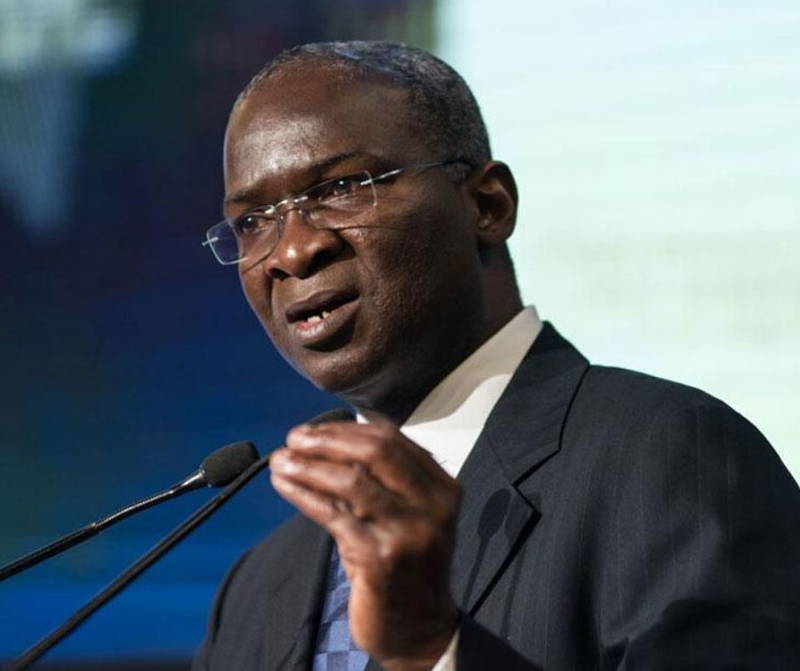
Former Lagos State Governor, Babatunde Fashola, has admitted that the All Progressives Congress (APC) was caught off guard by Peter Obi’s victory in Lagos State during the 2023 presidential election, insisting that the party would not allow a repeat of the upset.
Obi, who contested the election on the platform of the Labour Party, defeated the APC presidential candidate, Bola Tinubu, in Lagos, the state where Tinubu had served as governor and built much of his political base.
Official results showed that Obi secured 582,454 votes against Tinubu’s 572,606, winning by a margin of 9,848 votes.
Speaking in an exclusive interview with ARISE News, Fashola expressed confidence that the APC had learnt important lessons from the outcome.
“We were blindsided. It won’t happen again,” he said.
Asked to explain what he meant by being blindsided, the former governor said the party’s pre-election surveys had not indicated that Lagos was seriously at risk.
“Lagos didn’t look like a battleground at the time, not from the numbers,” he said.
He rejected the suggestion that the APC had taken the state for granted, explaining that the party relied on what he described as scientific surveys.
“We do very scientific surveys, and Lagos didn’t look like a battleground in that sense. So that’s why I say I was blindsided, on reflection,” he said.
Fashola maintained that the APC recovered quickly from the presidential election setback, pointing to subsequent electoral outcomes in the state.
“In spite of that setback at the presidential election, we turned it around very quickly,” he said.
He urged political parties to focus on issues, policy alternatives and their records in government rather than resort to hate speech, personal attacks and political violence.
“You are entitled to very vigorously and vociferously campaign for your party, as I am doing now, and showing what our record is, without damaging anybody’s name, anybody’s reputation, and without hate speech,” he said.
Describing democracy as a “non-contact sport”, Fashola said elections should be contests of ideas, policies and performance rather than intimidation.
Tinubu’s political relationships
Fashola urged Nigerians to examine the political relationships surrounding President Tinubu and his political rivals, arguing that the ability to retain longtime associates and attract former opponents was an important measure of leadership.
He said voters should look beyond campaign promises and consider the political history of presidential candidates, particularly their relationships with people who had worked closely with them.
“Where are all the people? That’s a job reference question,” he said.
“Why is it only President Tinubu has all the people who worked with him still with him?”
According to Fashola, many of Tinubu’s political associates remained loyal to him even during the years he was out of government before eventually becoming president.
He described the enduring relationships as evidence of Tinubu’s ability to work with people, an attribute he said was essential for governing a diverse country like Nigeria.
“It shows an ability to work with others,” he said.
“If you are going to get entrusted with managing Nigeria’s diversity, you must be able to work with people.”
Fashola contrasted Tinubu’s political journey with those of his presidential rivals, arguing that some had abandoned the political parties that brought them to prominence and parted ways with former associates.
“There was crisis in the APC. He didn’t leave the party,” he said.
“The others have left the party that brought them to prominence. They’ve left people who worked closely with them.”
He also argued that Tinubu had expanded his political network by bringing former opponents into his political coalition.
“All of the people who opposed Tinubu, when he used to be called the last man standing, all of them are now working with him,” he said.
“Not just those who worked with him before. Those who opposed him are now working with him.”
Fashola attributed the APC’s growing political influence across several states to Tinubu’s coalition-building ability, describing it as a remarkable political achievement.
“That’s how he has built a coalition of 30 state governments from one state, from Lagos,” he said.
“And that is profound, whether you like him or not.”
He maintained that the ability to retain allies, accommodate former opponents and build political coalitions should be considered when Nigerians assess presidential candidates.
INEC and electoral integrity
Fashola cautioned against placing the responsibility for Nigeria’s electoral challenges solely on the Independent National Electoral Commission (INEC), arguing that politicians, electoral officials and voters all had important roles to play in ensuring credible elections.
He said Nigerians must also examine their own conduct when assessing the credibility of the electoral process.
“What kind of democracy do they want?” he asked.
“The outcome is as good as participants want to make it.”
He urged citizens to obey electoral regulations, avoid manipulating voter registration and voting processes, monitor proceedings at polling units and keep records of results announced at their respective polling stations.
On concerns about the independence of an INEC chairman appointed by an incumbent president seeking re-election, Fashola asked: “Which INEC chairman has not been appointed by the president?”
He argued that the INEC chairman’s role during presidential elections should be understood within the broader electoral process, which involves the transmission and collation of results from polling units through various levels.
“In the presidential election, he’s the returning officer,” he said.
“He sits in that conference hall, or wherever he designates, and waits for the results to come from the states.”
According to him, greater attention should be paid to activities at polling units and throughout the collation process rather than concentrating scrutiny exclusively on the national electoral chairman.
“If there has been any failure of the process, it has taken place in the remote 176,840 polling units where you and I have operated,” he said.
Fashola acknowledged the difficulties involved in conducting elections simultaneously across thousands of locations, noting that the process depends on the actions of numerous electoral personnel.
“It’s never a perfect undertaking,” he said.
“176,000 people can’t behave the same way in 176,000 different locations.”
He also identified the roles of returning officers and academics appointed to supervise aspects of the collation process, arguing that electoral integrity required accountability at every level.
He urged voters to remain at polling stations and monitor the counting of ballots.
“Stay and watch where ballot votes are counted,” he said.
Tinubu deserves credit for Eko Atlantic
The former governor defended Tinubu’s claim that he “tamed the Atlantic” in Lagos, revealing that he personally drafted several letters to former President Olusegun Obasanjo on Tinubu’s instructions, seeking federal intervention over coastal erosion.
Fashola, who served as Tinubu’s Chief of Staff before succeeding him as Lagos governor in 2007, said the initiative that eventually developed into the Eko Atlantic project originated during Tinubu’s administration.
“Let me set the record straight,” he said.
“When the President says he tamed the Atlantic, he tamed it. Nobody should take the credit.”
He recalled that he was directly involved in correspondence with the Obasanjo administration as Lagos sought assistance to address the threat posed by the Atlantic Ocean to Victoria Island and surrounding communities.
“I was the Chief of Staff. I drafted those letters on his instructions to President Obasanjo,” he said.
According to him, the requests were repeatedly rejected, but Tinubu remained determined to find a solution.
“There were several letters to Obasanjo. Obasanjo would reply, ‘No.’ He would say, ‘Write another one.’ I would draft it,” Fashola recalled.
He said he still had copies of the correspondence in his personal records.
Fashola explained that Lagos eventually pursued an alternative arrangement through a partnership with South Energyx Nigeria Limited, leading to the development of Eko Atlantic.
He recalled that the project initially attracted considerable scepticism, with questions raised about the company involved and the feasibility of reclaiming land from the Atlantic Ocean.
However, he argued that the development had since demonstrated the economic and infrastructural benefits of the initiative.
“All the waterfront properties are there. Banks are back. Restaurants are back. Hotels are back. There’s a road. A big shopping mall has opened there,” he said.
“That is what infrastructure does — a new town.”
Fashola said his responsibility as governor was to protect and continue a vision initiated by his predecessor rather than claim ownership of the project.
“The idea was his,” he said.
He added that the area had previously suffered severe coastal erosion, with the Atlantic threatening adjoining parts of Victoria Island and flooding roads around Ahmadu Bello Way and the Federal Palace Hotel axis.
“I believed in it. I continued it. The result is there,” he said.
Rejects death penalty for election riggers
Fashola has rejected calls for election riggers to face the death penalty, insisting that electoral offences should attract firm punishment within the confines of the law.
The Senior Advocate of Nigeria and former Minister of Power, Works and Housing said Nigeria must move away from extreme political rhetoric as the country approaches the 2027 general election.
Reacting to the “rig and die” slogan attributed to former Deputy Senate President Ovie Omo-Agege and comparisons with former President Muhammadu Buhari’s controversial comments on ballot-box snatchers ahead of the 2019 elections, Fashola said capital punishment was excessive.
Asked directly whether election riggers should be executed, he responded: “Absolutely not. I mean, come on.”
“I think we must move away from what I think are extreme narratives and rhetoric,” he said.
“The punishment under the Electoral Act is not death. And even if it were death, which I will not support, there’s a process before you take human life; a charge, a trial, an opportunity to defend yourself.”
He maintained that political parties and their supporters must condemn electoral manipulation while avoiding threats and violence.
“The penalty for rigging is not death. But don’t rig. Go and campaign for your party,” he said.
Fashola argued that political parties should concentrate on mobilising supporters in areas where they enjoy popularity and improving their performance in areas where they are less popular instead of attempting to manipulate election results.
He, however, advocated tougher custodial sentences for serious electoral offences, particularly those capable of undermining democracy.
“I think maybe there might be stiffer sentences without option of fine, maybe a defined custodial sentence that is deterrent in nature,” he said.
“I always hold the view that some very serious, really impactful conduct should not be allowed to be monetised, and undermining of democracy is seriously impactful.”
On the possibility of introducing the death penalty, he remained firm.
“I don’t think it goes that far,” he said.
Fashola also called for sustained public enlightenment on electoral conduct, arguing that Nigeria had repeatedly amended its electoral laws without giving comparable attention to educating citizens about democratic principles.
He proposed nationwide civic education beginning from primary school and delivered in Nigeria’s major languages to promote responsible political participation.
Funsho Williams’ murder shaped my resolve on security — Fashola
Fashola has recalled how the murder of Lagos governorship aspirant Funsho Williams brought home the dangers of political participation, saying the incident made him realise that seeking public office could cost him his life.
Williams was murdered at his Ikoyi residence in Lagos, and the failure to secure a conviction in the case remains a source of concern.
Reflecting on the incident and its impact on his decision to enter the Lagos governorship race, Fashola said it exposed the risks associated with politics.
“It showed me that, for me, it was like, look, listen, if you’re doing this election thing, this is it. These are the odds. You can lose your life in the process,” he said.
He, however, said the incident did not discourage him from seeking office.
“As I told friends of mine, for me, speaking for myself at the time, it was worth dying for, to serve the country,” he said.
Fashola said the experience strengthened his determination to promote law and order and confront political violence.
“My resolve was to then, from there, enthrone law and order, remove violence from our country,” he said.
He highlighted some of the security initiatives undertaken by his administration, including strengthening the Lagos State Ministry of Justice’s prosecution capacity, supporting police reforms through the Rapid Response Squad, establishing the Lagos State Security Trust Fund and providing equipment and other resources for law enforcement.
He also recalled providing life insurance protection for security personnel whose duties exposed them to dangerous situations.
On the failure to secure a conviction for Williams’ murder, Fashola said the case demonstrated the importance of effective criminal investigation and evidence gathering.
“The justice system involves a process of investigation,” he said.
He called for stronger forensic investigation capabilities, including the use of DNA evidence, fingerprints, blood samples and other biological materials to establish connections between suspects and crimes.
Fashola also lamented the destruction of a DNA facility during a protest, warning that attacks on such infrastructure weakened the country’s capacity to investigate and prosecute serious crimes.
He said unresolved murder cases underscored the need for highly skilled investigators capable of revisiting difficult cases and following available evidence, regardless of how much time had passed.
11 million Nigerians gained electricity under my watch — Fashola
Fashola has said more than 11 million Nigerians gained access to electricity during his four-year tenure as Minister of Power, describing the achievement as one of the records he remains proud of.
“At that time, we connected, I think, 11 million-plus people to electricity supply for the first time in the history of this country,” he said.
“That is a record I’m proud of. Eleven million people extra have access to electricity.”
He acknowledged that expanding electricity access was different from guaranteeing reliable supply, explaining that his administration had adopted a gradual approach towards improving power delivery.
“I promised them incremental energy. And I said we will get to stable power before we go to uninterrupted power,” he said.
Fashola argued that Nigeria’s electricity challenges must be understood against the background of the restructuring and privatisation of the sector in 2013.
Under the arrangement, generation and distribution were transferred to private operators, while the Federal Government retained responsibility for transmission.
He said the restructuring fundamentally changed the government’s role in electricity delivery and reduced the direct involvement of the Federal Government in the generation and distribution segments.
Consequently, he argued that electricity distribution and generation companies should be held accountable for the services they provide rather than placing the entire responsibility for electricity supply on the Federal Government.
Bureaucracy, not corruption, trapped power equipment at ports — Fashola
Fashola has blamed bureaucratic bottlenecks and procurement constraints for the prolonged delay in clearing more than 1,000 containers of electricity equipment stranded at Nigerian ports during his tenure as Minister of Power.
He said he was initially surprised that equipment imported to improve Nigeria’s electricity infrastructure could remain trapped at the country’s ports.
“Is it an alien port? It’s our port. Go and get the thing out of there,” he recalled thinking when he first encountered the problem.
However, further investigation revealed a complicated chain of contractual and financial challenges involving government procurement procedures, changing prices and outstanding payments to shipping and warehousing companies.
“When you contract with the government, most of this equipment had to be ordered,” he said.
“In the process of ordering, prices changed. There were no budgetary provisions. So, the contractor then looked at it and said, ‘If you don’t review my contract, my profit is gone.’”
He explained that shipping and warehousing charges continued to accumulate while the equipment remained uncleared, making the situation increasingly difficult to resolve.
Fashola said his administration eventually recovered 910 containers, cancelled most of the affected contracts and recalled engineers with experience from the former National Electric Power Authority (NEPA) and the Transmission Company of Nigeria (TCN) to assist in deploying the equipment.
“We cancelled most of the contracts. We called back the engineers from the old NEPA and TCN. They were the ones who were installing those equipment,” he said.
He added that the recovered equipment was subsequently deployed to electricity infrastructure projects across the country.
Fashola said the experience exposed fundamental weaknesses in Nigeria’s public procurement system, which he argued was too slow to support the country’s infrastructure development needs.
“I was one of the very vocal voices while I served about the difficulty of our procurement law,” he said.
He explained that restrictions on advance payments could expose contractors to significant price fluctuations between the award of contracts and the eventual manufacture and importation of equipment.
“If, for example, those contractors had been paid up to 70 per cent, they would have imported the equipment, brought it in before prices changed,” he said.
“But they give them 15 per cent, and while production is going on, the price suddenly changes.”
He maintained that delays in public projects should not automatically be attributed to corruption.
“It’s less of corruption than the bureaucracy of public service,” he said.
The former minister called for reforms to procurement procedures to ensure that regulations designed to protect public funds did not become obstacles to delivering critical infrastructure.
Fashola advocates electricity decentralisation
Fashola has identified the decentralisation of electricity regulation and supply as a major opportunity for improving power delivery across Nigeria, particularly through greater participation by state governments.
He said he could no longer speak authoritatively about the day-to-day operations of the Federal Ministry of Power because he no longer had access to the detailed operational information available to him while in office.
“I can’t speak about that ministry anymore,” he said. “I don’t have the detail I used to have.”
However, he argued that the removal of previous restrictions on state participation in electricity generation and distribution had created a more favourable environment for governors to develop solutions suited to their respective states.
“Well, I think that decentralisation has already happened,” he said.
Recalling his tenure as Lagos governor, Fashola said his administration had made efforts to provide electricity to streets, communities, schools and other public institutions despite the legal restrictions that existed at the time.
“If, when I was governor, I had this enabling environment, I don’t know what I would have done,” he said.
“We were powering streets, we were powering communities, we were powering schools, and we were powering many communal institutions at that time, in spite of the restrictions that we had.”
He said the current legal framework offered governors greater opportunities to intervene in electricity provision.
“This is a more enabling environment for governors to play an even bigger role,” he said, adding that Lagos State was already taking steps in that direction.
APC delivered infrastructure, PDP spent on fuel subsidy — Fashola
Fashola has contrasted the records of the Peoples Democratic Party (PDP) and the APC, arguing that previous PDP administrations spent substantial national resources sustaining fuel subsidies, while the APC delivered major infrastructure projects and reforms.
He said the subsidy system under previous administrations consumed foreign exchange that could otherwise have been invested in expanding Nigeria’s productive and industrial capacity.
“That administration ran a subsidy scheme that was impoverishing people in a way that they probably didn’t come to terms with,” he said.
“Because all our foreign exchange income was spent not on developing the economy, not on expanding its productive or industrial needs, but on paying for fuel.”
Fashola, who served as Minister of Power, Works and Housing under former President Muhammadu Buhari, argued that the subsidy regime contributed to rising debt and diverted government resources from critical development projects.
He contrasted the situation with what he described as the APC’s delivery of major infrastructure projects that had remained unresolved for several years.
“Big infrastructural ticket items, rail, major roads, the Second Niger Bridge that was a topical issue in every election cycle — all of these problems were solved under an APC government,” he said.
“A new port for this country was built under an APC government.”
He said improvements in infrastructure serving Nigeria’s ports had benefited traders, importers, exporters and industrialists whose businesses depended on the efficient movement of goods.
Fashola also cited the development of rail transportation as evidence of the APC’s efforts to address infrastructure bottlenecks.
“Rail transport in Nigeria, solved by an APC government, and that is helping businesses, that is helping people, that is helping the movement of goods and services that are needed,” he said.
He further cited the Petroleum Industry Act (PIA), enacted under the Buhari administration after years of unsuccessful attempts to reform the petroleum sector, as another major achievement.
According to him, the legislation helped establish a framework for restoring confidence in the petroleum industry and attracting investment.
Fashola also rejected arguments that the current cost-of-living crisis could be attributed solely to APC policies, pointing to the economic disruption caused by the COVID-19 pandemic and subsequent global developments.
While acknowledging the hardship confronting Nigerians, he maintained that government performance should be assessed against the structural problems addressed and the reforms undertaken.
He said the comparison between the PDP and APC should ultimately be based on their respective records in government.
“In terms of differential ideology, performance over a relatively shorter period, we have solved some of the biggest problems in Nigeria’s household,” he said. (THISDAY)
-
 News18 hours ago
Tinubu Approves Eastern Gas Pipeline, Rail Line, Pledges Better Power Supply to South-East
-
News1 day ago
2027: Enenche Leads Obi, Makinde, Dino Melaye, Others in Prayers for Peaceful Elections
-
News2 days ago
Davido, Patoranking, Zoro, Cubana Chief Priest Join Anyi Chuks As He Unveils Five-Point Agenda, Promises 180,000 Jobs In Ebonyi
-
News17 hours ago
Shettima Suggests Peter Obi for South-East Development Commission Chairmanship
-
News3 days ago
‘They Shot Me Five Times’ — NDC Supporter Recounts Attack on Omo-Agege’s Campaign Team in Delta
-
News1 day ago
Tinubu to Meet Southeast Leaders in Enugu Ahead of APC Presidential Campaign Rally
-
News2 days ago
23-Year-Old Nurse Found Dead in River as Former Boyfriend, Taxi Driver Face Murder Charges
-
News2 days ago
2027: Obi, Kwankwaso Draw Mammoth Crowd in Aba as NDC Campaign Gathers Momentum