News
FG seals popular Abuja Supermarket over price fixing


The Federal Competition and Consumer Protection Commission (FCCPC) on Friday morning sealed popular Abuja discount supermarket Sahad Stores.
It was learnt that Sahad Stores with origin from Kano was sealed by FCCPC for hoarding and fixing prices of food higher than the approved tag.

The sealing of Sahad Stores was enforced by the FCCPC’s acting chief executive vice-chairman Adamu Abdullahi.
He accused the Sahad Stores and its management of shortchanging customers by charging prices on foodstuff other than the price tag at the shelves.
The move came after President Bola Tinubu at a meeting with state governors unveiled plans to tackle factors responsible for food crisis across the country.

Speaking to newsmen on the sealing of Sahad Stores, Abdullahi said the commission’s preliminary investigation confirmed that the management of the supermarket were short changing customers.
He said that the store will remain sealed until the completion of further investigation.
Sahad Stores is one of the most popular supermarket outlets in Abuja and had won a reputation for their discount sales on household and domestic items including food items before it was sealed by FCCPC.
The FCCPC move comes as a big blow as the chain had recently opened its latest outlet in Mararaba, Nasarwa State to carter for those living in the outskirts of Abuja.
Giving further reason for sealing the supermarket, Abdullahi listed the offences committed by the store to include customers extortion and lack of transparency in prices, explaining that the act was an obnoxious practice that amounted to a violation of rights under the FCCPAct.
He said the practice contravened Section 155 (3) of the FCCPA and the fine amounted to N100 million or more.
”What we have found out that they are doing is misleading pricing and lack of transparency in their pricing which is against section 155 (3) of the FCCPAct.
”It is an obnoxious practice and amounts to violation of rights under the FCCPA.
”Section 155 of FCCPA states that any corporate person that contravenes this law is liable to a fine of N100 million or even more.
”We found out that they are contravening this law and made sure that we came to tell them that our mandate is very clear.
”What we have come here today to do is to make sure that they complied with the law.
”We called them to defend themselves but they failed to show up and in the long run, they sent a lawyer and the lawyer is not familiar with the case but we requested for names of people that we wanted to come and defend them.
”Those people refused to come and these are the people in charge of retail, fix prices on the computer system and shelves.
”We do not have a choice than to seal off the premises until they comply with the provisions of the law,” Abdullahi said
He said that the Commission would continue to protect the citizens in line with President Bola Tinubu’s agenda.
The acting executive vice chairman said the Commission would continue to monitor the supermarket to make sure they complied with the law.
Mrs Boladale Adeyinka, the Director Surveillance and Investigations Department of FCCPC, said that price tags on products on the shelves of the supermarket were different from prices at the pay point computers.
Adeyinka said that even the same products and brand had different prices.
”The same products, the same brand has different prices. One is N5,000 while one is N6,000.
”Imagine if you buy 10 pairs, that means you have been short-changed by N10,000.
”In this period, we want people to have maximum value for their money,” she said.
Mr Salisu Zango, an official of Sahad Supermarket, admitted that the store had engaged in the practice but had since made amends.
”We have corrected it,” he said.
The News Agency of Nigeria (NAN) reports that the supermarket premises was sealed off to avoid customers access. (NAN)













The Nigeria Police Force has uncovered and raided facilities known as phone farms, allegedly used to manipulate online conversations ahead of the 2027 general elections.
The police also arrested a suspect accused of circulating false information about a political candidate from the South-South region in an alleged attempt to influence voter behaviour and damage the candidate’s reputation.
Assistant Commissioner of Police, Bashir Abdullahi, disclosed this on Wednesday during a webinar titled ‘AI, Misinformation and Nigeria’s 2027 Elections: Safeguarding the Truth, Protecting the Vote’, organised by the PUNCH Media Foundation.
Abdullahi, who represented the Inspector-General of Police, Olatunji Disu, explained that phone farms are facilities where hundreds of mobile phones and automated accounts are deployed to create the impression that large numbers of people are discussing or promoting particular issues online.
He said the police discovered the facilities while investigating alleged coordinated attempts by some individuals to manipulate the electoral process.
“We have recently come across information regarding the coordinated effort being made by some individuals to see that they tamper with our elections. Having dissected the information, we were able to carry out targeted raids at phone farms,” he said.
Explaining how the facilities operate, Abdullahi said individuals deploy multiple mobile phones and bots to circulate information simultaneously, thereby manipulating public perception and creating artificial online engagement.
“They call it phone farms, where you have bots arranged to manipulate and spread information simultaneously, making you believe that a whole lot of people are talking about the same subject.
“Meanwhile, it is just an individual behind hundreds of phones, arranged in what they call a phone farm, so that they can manipulate the system. The police were able to disrupt this,” he added.
The police chief also disclosed that a suspect was in custody over the alleged circulation of false information about a political candidate from the South-South region.
According to him, the suspect allegedly spread misleading reports about activities that had either not taken place or were still in the pipeline, with the intention of influencing voter behaviour and discrediting the candidate.
“As I am talking to you now, we have somebody in our custody who came up with this kind of information regarding one of the candidates from the South-South part of the country, carrying information regarding things that were not done or that were in the pipeline and said that they were not done, just to predict voter behaviour, and then make them behave in a manner that is negatively targeted to disparage these candidates,” Abdullahi said.
He explained that the police investigated the complaint, traced the source of the information and subsequently arrested the suspect.
Abdullahi warned that the police would arrest and prosecute anyone found guilty of spreading false information capable of undermining the electoral process.
“What we are doing now is, first of all, to send the message that the police are ready to arrest any person found spreading false information.
“Two, we are going to carry out investigations. Three, we will ensure that such a person is prosecuted. This is a message for people not to even contemplate doing that kind of behaviour,” he said.
On the growing use of artificial intelligence to manipulate electoral information, Abdullahi said the police had acquired cyber solutions capable of detecting deepfake videos, manipulated photographs and cloned audio recordings with up to 99 per cent accuracy.
He identified AI-generated videos, manipulated photographs and voice cloning as potential threats to the 2027 elections, warning that the technologies could be used to make candidates, public officials and electoral authorities appear to have made statements they never uttered.
He added that the police were conducting digital forensic examinations of audio recordings, videos and photographs circulating on social media as part of efforts to identify manipulated content.
According to him, the force had also established an election monitoring room and commenced intelligence gathering ahead of the polls.
However, Abdullahi stressed that the police would not interfere with legitimate public opinion, noting that investigations and enforcement actions would be guided by established legal provisions.
“If the relevant legal elements are not established, we cannot go out and disrupt the peaceful conduct of public opinion. We cannot do that,” he said.
He urged Nigerians to verify election-related announcements through the Independent National Electoral Commission (INEC), particularly reports concerning changes to the election timetable.
The Economic and Financial Crimes Commission (EFCC) has recovered $3 million and ₦1.303 billion from Aiteo Exploration and Production Limited and Newcross Exploration & Production Limited over outstanding statutory payments owed to the Federation.
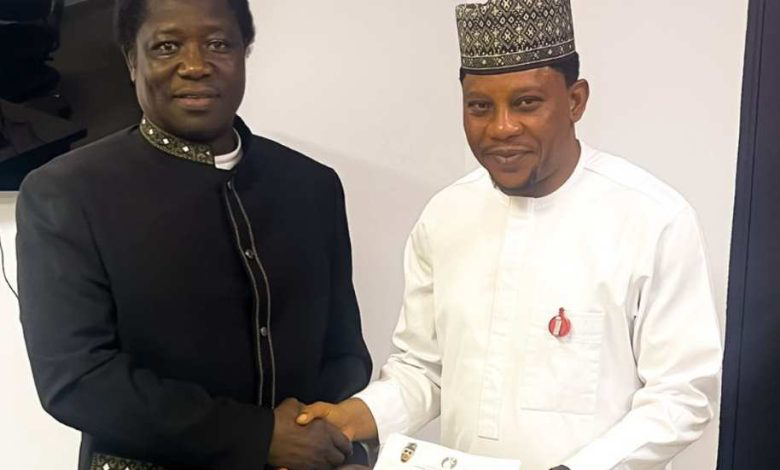
The recovered funds were formally handed over to the Revenue Mobilisation Allocation and Fiscal Commission (RMAFC) on Monday, November 10, 2026, by the Acting Zonal Director of the EFCC’s Lagos Zonal Directorate 2, ACE I Bawa Usman Kaltungo.
The recovery followed an investigation launched by the EFCC after receiving a petition from a consulting firm engaged by RMAFC. The petition alleged conspiracy, tax evasion and economic sabotage through the failure of the two companies to remit revenues accruable to the Federation.
Specifically, the companies were accused of failing to remit statutory revenues arising from stamp duties and pipeline transportation fees into the designated accounts of the Federation.
The affected facilities included Escravos, Pennington, Trans-Forcados, Odudu, Amenam and Nembe Creek Trunkline, with the alleged non-remittances resulting in substantial revenue losses between 2010 and 2019.
In response, RMAFC secured a presidential fiat dated December 20, 2021, authorising it to recover all outstanding revenues due to the Federation from the affected public and private entities.
Following the commencement of investigations, Aiteo and Newcross submitted relevant documents detailing their respective remittances from their operations.
However, a review and analysis of the documents revealed that Aiteo failed to remit $38.43 million, representing 1.5 per cent stamp duty arising from its acquisition of Oil Mining Lease (OML) 29 and the Nembe Creek Trunkline (NCTL).
Similarly, investigations established that Newcross failed to remit $22,841,662.03 in crude oil transportation fees for its use of the Nembe Creek Trunkline, which is operated as a joint venture between the Federal Government and Aiteo.
The two companies subsequently acknowledged their respective liabilities and commenced payments towards settling the outstanding obligations through the EFCC’s recovery accounts domiciled with the Central Bank of Nigeria (CBN).
Further recovery efforts resulted in additional payments between January 28 and August 24, 2026.
During the period, Aiteo paid $1.5 million and ₦750 million into the EFCC recovery account towards settling its outstanding stamp duty obligations.
Newcross, on its part, paid $1.5 million and ₦553.128 million towards settling outstanding pipeline transportation and terminal fees.
The payments brought the total recovery from the two companies to $3 million and ₦1,303,128,000, representing the funds formally handed over to RMAFC.
The recovery is expected to strengthen the Federation’s revenue base and underscores the importance of enforcing statutory payment obligations in the oil and gas sector, particularly in safeguarding public revenue from transactions involving petroleum assets and infrastructure.
News
DSS intercept weapons shipment from Niger Republic, recover 21 AK-47 rifles, four PKT Machine Guns in Sokoto
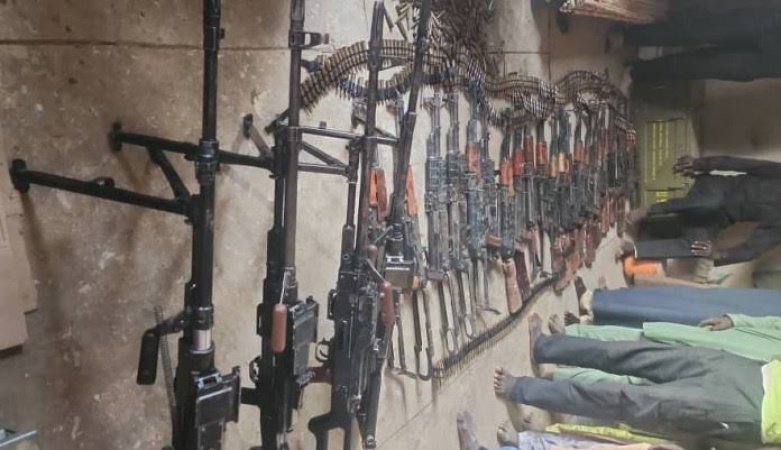
The Department Of State Security Service (DSS) have intercepted a large consignment of weapons and ammunition allegedly being smuggled from the Niger Republic to armed bandits operating in north-western Nigeria.
The interception, which took place on Tuesday, November 10, at Dawakawa in Goronyo Local Government Area of Sokoto State, followed a security operation targeting suspected weapons trafficking networks across the Nigeria-Niger border.
Security sources said the suspected smugglers were allegedly attempting to transport the weapons into Nigeria using camels, apparently exploiting remote routes and difficult terrain to evade security surveillance.
The operation led to the recovery of 21 AK-47 rifles, four PKT machine guns and 825 magazines.
The interception represents a significant disruption of an alleged cross-border weapons supply network suspected of facilitating the operations of armed bandit groups in the North-West.
The use of camels to transport the weapons highlights the increasingly unconventional methods employed by criminal networks to move arms and ammunition across porous border corridors.
The development also underscores the importance of sustained intelligence surveillance coordinated border security operations in preventing the movement of illicit weapons from neighbouring countries into Nigeria.
The recovered weapons are expected to provide security agencies with valuable leads towards identifying the suppliers, transporters and intended recipients of the consignment.
Zagazola report that several border communities along the Nigeria–Niger Republic frontier have emerged as vulnerable corridors for cross-border arms trafficking, bandit movements and other criminal activities, raising concerns over the security of Nigeria’s North-West.
The affected areas include Illela, Sabon Birni, Isa, Gudu and Tangaza in Sokoto State; Jibia, Kaita, Mai’Adua and Kongolam in Katsina; Zurmi and Shinkafi in Zamfara; as well as Kamba and Arewa Dandi in Kebbi State.
Security concerns around these border regions are linked to porous boundaries, informal trading networks and difficult-to-monitor rural terrain, which criminal networks like Bandits, Lakurawa and Boko Haram exploit for illicit activities.
The development reinforces the need for enhanced border surveillance, intelligence-sharing and coordinated operations to dismantle cross-border weapons supply networks.
Security agencies must also target the financiers and suppliers behind the trafficking networks rather than focusing solely on couriers. (Zagazola)
-
 News2 days ago
Canada Opens Permanent Immigration Pathway for Skilled Foreign Workers in Rural Communities
-
News1 day ago
Gbajabiamila Admits Nigerians Are Facing Economic Hardship Amid Tinubu’s Reforms
-
News2 days ago
Two Convicted Inmates Escape From Okene Custodial Centre, NCoS Confirms
-
News7 hours ago
DSS intercept weapons shipment from Niger Republic, recover 21 AK-47 rifles, four PKT Machine Guns in Sokoto
-
News2 days ago
Bandits Set Family Ablaze, Kill 12 in Horrific Zamfara Attack
-
News3 days ago
Mbah Appoints Nollywood Actress Destiny Etiko as SSA on Youth Engagement, Creative Economy
-
News3 days ago
Obi Accuses NFF Officials Of Preventing Him From Greeting Victorious Flamingos
-
News2 days ago
2027: Enugu Unity Forum Begins Grassroots Mobilisation for Tinubu, Mbah, APC