Connect with us

News

Binance breached Nigerian law, operated Naira P2P in exchange of crypto assets – Witness

Published

on

Detained Binance executive, Tigran Gambaryan
Spread the love

A Director with the Security and Exchange Commission (SEC), Abdulkadir Abbas, on Friday, told a Federal High Court, Abuja how Binance Holdings Ltd breached the Nigerian law to operate naira peer-to-peer services in exchange of crypto assets.

Abbas, the Director of Registration, Exchanges and Market Infrastructure Department at SEC, disclosed this while testifying before Justice Emeka Nwite in the trial of Binance and two of its officials on a charge bordering on money laundering.

Abbas, the 1st prosecution witness (PW1), said that due to the large number of Nigerian users, who were leveraging on the model, it adversely affected the official exchange rate.

“As a matter of fact, the Binance platform became a reference point for determining the exchange rate,” he added.

The News Agency of Nigeria (NAN) reports that the Economic and Financial Crimes Commission (EFCC) had filed a 5-count charge against Binance and Tigran Gambaryan as 1st and 2nd defendants, while listing Nadeem Anjarwalla as being at large.

Maduka College Advert

Led in evidence by prosecuting lawyer, Ekele Iheanacho, Abbas said the operations of company negatively impacted Nigeria’s financial system.

The director, who is the 1st prosecution witness (PW1), told the court that not only did Binance operate in Nigeria illegally, its mode of operation circumvented the normal currency trading route put in place by regulators.

The witness said he met Gambaryan once during a meeting at the office of the National Security Adviser (NSA).

Abbas said Binance and its officials were invited by the NSA to the meeting to discuss its operations and the impact on the Nigerian economy.

“At the meeting, it was clearly observed that the 1st defendant (Binance)’s mode of operation is against the provision of the Investment and Securities Act, 2007

“Apart from not being registered in Nigeria and making public solicitation without authorisation, the 1st defendant operates a naira peer-to-peer (P2P) in exchange of crypto assets.

“The naira P2P being deployed in the transaction, circumvent the normal trading route.

“This is because the Central Bank of Nigeria (CBN) has banned banks from providing certain settlement platforms for crypto exchange.

“As a result of the naira P2P deployed by Binance, and coupled with the large number of Nigerian users, who were leveraging on that model, it adversely affected the official exchange rate,” he said.

According to him, the naira P2P model created uncertainty and high level of volatility in the exchange rate as Nigerian users trade arbitrarily on the platform, thereby impacting negatively on financial system stability.

“The naira P2P rate quoted on Binance’s platform, is not referencing any official rate and its continuous operation affects the value of our naira.

“This was one of the serious concerns raised at the meeting we had at the office of the NSA,” the PW1 said

He added that the rate at which naira was being sold on Binance’s platform had no relationship with the official exchange rate.

Abbas said the rate on Binance’s platform was not driven by any fundamentals, adding that it got to a stage where the value of the naira was determined based on the rate quoted on Binance’s platform.

He said the rate had no correlation or relationship with the official rate.

He said by operating its platform, which was not registered or regulated by the SEC in Nigeria, Binance was in breach of the extant provisions of the Investment and Securities Act, 2007

“In addition, by making public solicitation to Nigerians without due authorisation by the SEC, the 1st defendant violated the Investment and Security Act,” the witness said.

At the conclusion of his evidence-in-chief, lawyer to Binance, Babatunde Fagbohunlu, SAN, said he needed to retrieved some documents from the court with which he planned to cross examine the witness.

Fagbohunlu said he submitted an application to that effect earlier in the day, which was not yet approved.

He sought a short stand down to enable him confirm if his application was approved and if the documents could be made available to him.

Justice Emeka Nwite noted that since his application was filed today, it might be difficult to have it approved if the case was stood down.

Justice Nwite elected to adjourn till May 23 at 12 noon for cross examination.

NAN reports that Anjarwalla, who was in lawful custody with Gambaryan, escaped and fled the country on March 22.(NAN)


News

Court Orders Interior Minister Tunji-Ojo to Respond to Suit Seeking Release of His NYSC Records

Published

on

Minister knocks NIS for asking married women to travel to Abuja for change of name
Bunmi Tunji-Ojo, Minister of Interior
Spread the love

The Federal High Court in Abuja on Monday ordered the Minister of Interior, Olubunmi Tunji-Ojo, to respond to a suit seeking to compel the release of records of his National Youth Service Corps (NYSC) scheme.

Justice Salim Ibrahim gave the order when the matter came up for hearing.

The Incorporated Trustees of Pathway to Equity and Charity Foundation had filed the suit, marked FHC/ABJ/CS/1812/2026.

The group prayed the court to compel the NYSC to disclose documents supporting the minister’s claim that he completed the mandatory one-year national service.

The foundation also sought an order of mandamus directing the Federal Capital Territory Administration (FCTA), the 2nd respondent, to produce records showing that the minister did his primary assignment at the FCTA.

Maduka College Advert

When the case was called, counsel to the applicant, Chief Solomon Akuma, SAN, told the court he was ready to proceed with the hearing.

However, Abiola Olaniji, who appeared for the minister, said he had filed an application for Tunji-Ojo to be joined as the 3rd respondent.

Olaniji said the applicant (foundation) had responded with a counter affidavit raising serious issues, to which he needed time to reply.

The lawyer stated that the minister was ready to take part in the proceedings as an interested party.

But Akuma opposed the application, arguing that the minister was not a proper party.

He said the suit only sought an order of mandamus compelling the respondents (NYSC and FCTA) to produce documents that are not in the minister’s custody.

Justice Ibrahim directed the minister to file and serve his reply to the applicant’s counter affidavit, which opposed his application to be joined as a party in the suit before the next hearing date.

The judge then adjourned the matter until Oct. 18 for hearing.

The applicant had sought from the NYSC the mobilisation or call-up letter issued to Tunji-Ojo in 2006 or any other year; the posting letter to the FCTA in 2006 or any other year; and his application for mobilisation.

It also sought the evidence of approval of his remobilisation by the NYSC’s Director-General; evidence of payment of allowances to him; the record of his Community Development Service and his discharge certificate.

The foundation equally sought from the FCTA, the mobilisation or call-up letter, the posting letter, his attendance record during the service year, evidence of any allowance paid to him, among others.

It said the application was brought under Section 14 of the Federal High Court Act, Order 34 Rules 1, 2 and 5 of the Federal High Court (Civil Procedure) Rules 2019.

It also cited Sections 20, 21 and 25 of the Freedom of Information (FOI) Act, 2011.

(NAN)

Continue Reading

News

Reject money requests from home, Obi tells UK-based Nigerians

Published

on

Labour Party knocks Middle Belt movement for allegedly gagging Peter Obi
Peter Obi
Spread the love

The presidential candidate of the Nigeria Democratic Congress, Peter Obi, has advised Nigerians residing in the United Kingdom to stop sending money to people who seek financial help at home.

Obi also advised them to urge their relatives to vote for productive leaders.

He made the remarks at a town hall meeting with diaspora supporters in Manchester, United Kingdom, on Sunday.

He stressed that Nigeria’s prevailing economic hardship resulted from bad leadership, arguing that continuous financial assistance only cushions the effects of poor governance without addressing the root causes.

“You have people at home in Nigeria today who are begging you for money. Tell them no!” he said.

Maduka College Advert

The former Anambra State governor insisted that his record in public office distinguished him from other governors, claiming none of them matched his achievements in saving public funds.

“I’m not saying I’m a saint, but I saved money. I’ve not seen one governor who has saved 10 per cent of what I saved. No governor has done it.

“Let’s start with this one that is less corrupt. That’s how other countries change.”

He maintained that his conversations with the people reinforced the need for collective responsibility, stressing that building a new Nigeria would require citizens to take an active role in addressing challenges facing the country.

Obi also urged Nigerians to take the 2027 election seriously, describing the contest as a critical moment for the nation.

Continue Reading

News

Federal High Court Upholds ENSSAA’s N150m Political Campaign Billboard Fee, CTC Reveals

Published

on

Spread the love

Contrary to false and misleading reports on social media that a Federal High Court (FHC) sitting in Abuja had nullified the N150 million fee prescribed by the Enugu State Structures for Signage and Advertisement Agency (ENSSAA) for political campaign billboards, findings have revealed that the court actually ruled in favour of the agency, upholding its powers to prescribe the fee.

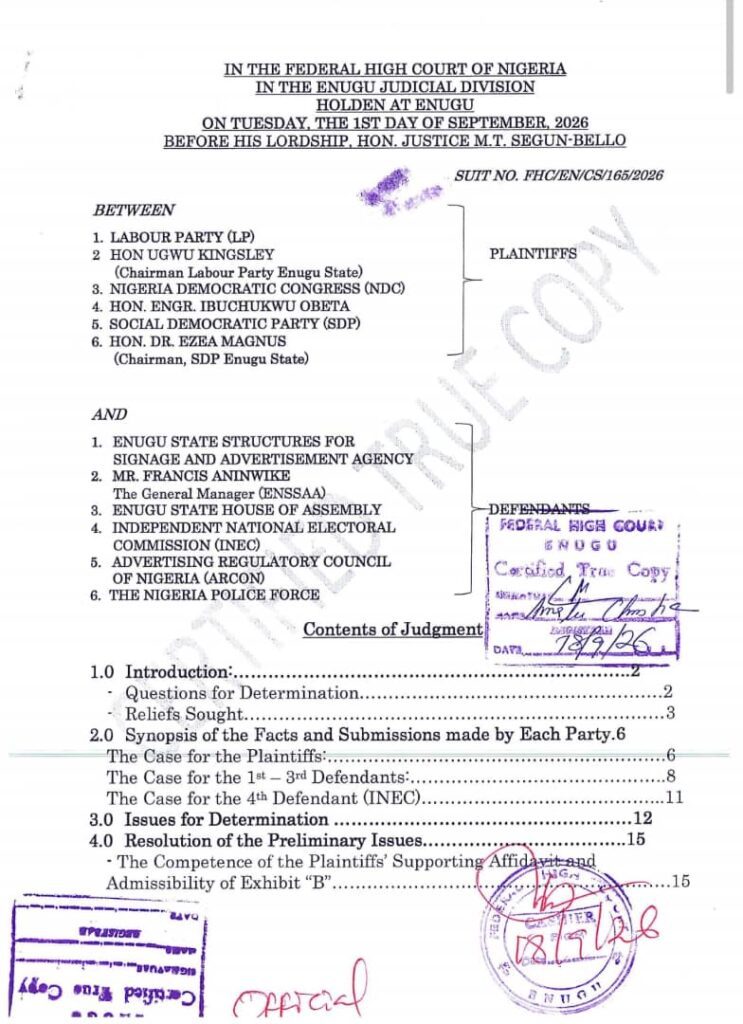
According to a certified true copy (CTC) of a judgment of FHC sitting in Enugu, the court had on September 1, 2026, dismissed a suit by opposition parties and figures challenging ENSSAA’s authority to impose a mandatory N150 million fee on each political party seeking to erect campaign billboards or display posters ahead of the 2027 general election.

The judgment rendered by Justice Mabel Segun-Bello held that it was within the legislative competence of the Enugu State House of Assembly to make laws on outdoor advertising and for ENSSAA to exercise powers donated to it by state law.

The suit marked FHC/EN/CS/165/2026 had the Labour Party; Chairman of the Labour Party (LP) in Enugu, Hon. Kingsley Ugwu; Nigeria Democratic Congress (NDC); NDC factional state Chairman, Engr. Ibuchukwu Obetta; the Social Democratic Party (SDP) and its state Chairman, Hon. Magnus Ezea, as plaintiffs, while ENSSAA; its General Manager, Mr. Francis Aninwike; the Enugu State House of Assembly; Independent National Electoral Commission (INEC); Advertising Regulatory Council of Nigeria (ARCON); and Nigeria Police Force were the respondents or defendants.

The plaintiffs had in June 2026 approached the court seeking a declaration that, by virtue of Sections 99 (1) and (2) of the Electoral Act, 2026, and Section 153 of the 1999 Constitution, which donated exclusive powers to INEC to regulate electoral campaigns of political parties in Nigeria, it was ultra vires the powers of ENSSAA and its General Manager to make executive decisions and publications imposing a mandatory payment of N150 million by political parties and their candidates in the state as an advertisement permit fee for the placement of billboards for the council election and the 2027 election.

Maduka College Advert

They equally sought a declaration by the court that it was unlawful and ultra vires the legislative powers of the Enugu State House of Assembly to make laws regulating the advertisement of political campaigns in the state.

Consequently, the plaintiffs sought an order of the court setting aside the mandatory N150 million fee, as well as an injunction restraining the agency and its GM, the Enugu State Government, its agents and representatives from enforcing ENSSAA’s executive directive.

They finally sought an order of the court mandating the Nigeria Police Force to protect political parties in Enugu State against possible harassment for the placement of billboards and posters for the council election and the 2027 elections.

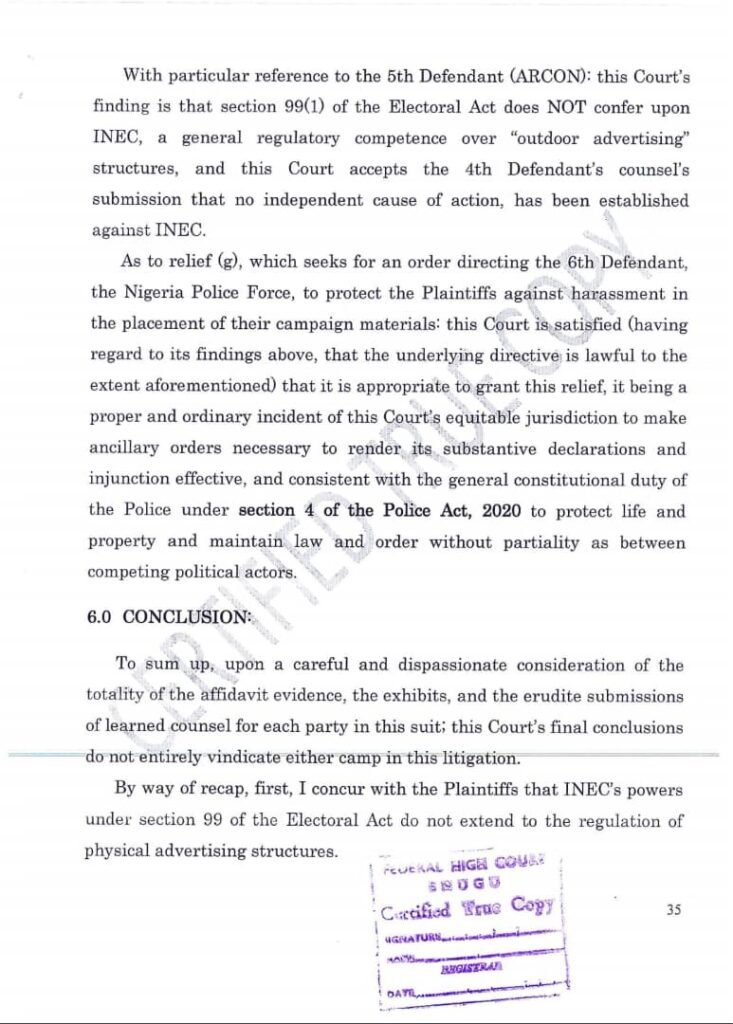
However, delivering her judgment in September, after a careful consideration of the totality of the affidavit evidence, the exhibits, and submissions by both parties, the presiding judge, Justice Mabel Segun-Bello, held, among other things, that the National Assembly does not hold exclusive legislative powers over outdoor advertising.

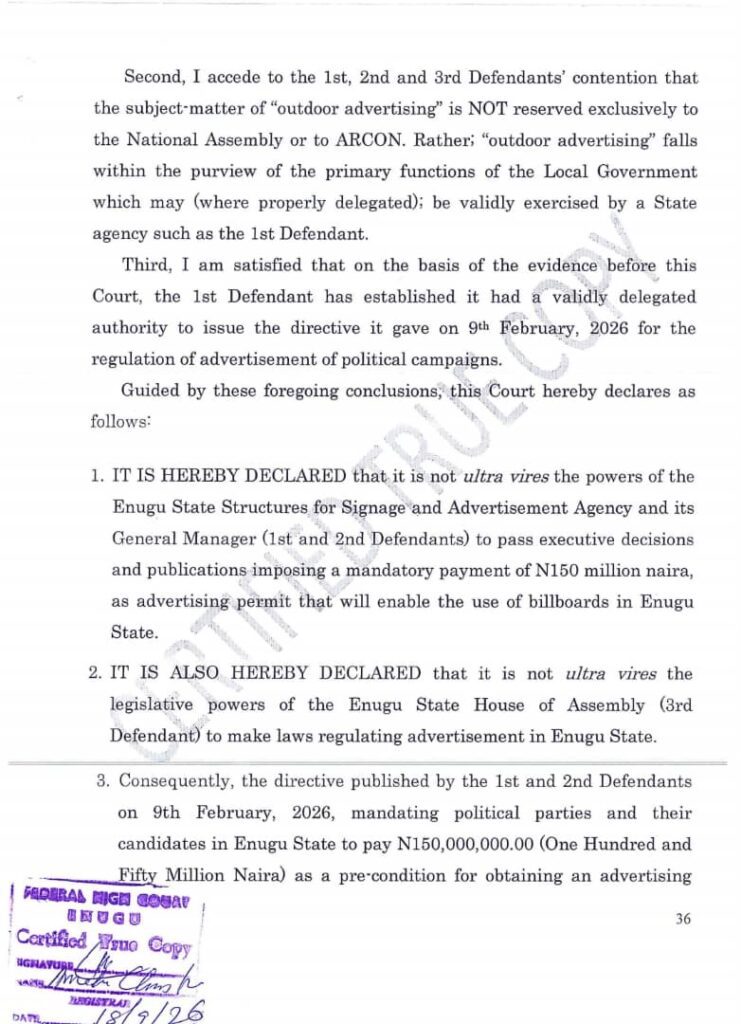
“I accede to the 1st, 2nd and 3rd Defendants’ contention that the subject matter of ‘outdoor advertising’ is NOT reserved exclusively to the National Assembly or to ARCON.

“Rather, ‘outdoor advertising’ falls within the purview of the primary functions of the Local Government, which may (where properly delegated) be validly exercised by a State agency such as the 1st Defendant (ENSSAA).

“Third, I am satisfied that on the basis of the evidence before this Court, the 1st Defendant has established it had a validly delegated authority to issue the directive it gave on 9th February, 2026, for the regulation of advertisement of political campaigns,” she stated.

Guided by these foregoing conclusions, Justice Segun-Bello held that “it is not ultra vires the powers of the Enugu State Structures for Signage and Advertisement Agency and its General Manager (1st and 2nd Defendants) to pass executive decisions and publications imposing a mandatory payment of N150 million naira, as advertising permit that will enable the use of billboards in Enugu State.”

Continuing, she said, “It is also hereby declared that it is not ultra vires the legislative powers of the Enugu State House of Assembly (3rd Defendant) to make laws regulating advertisement in Enugu State.

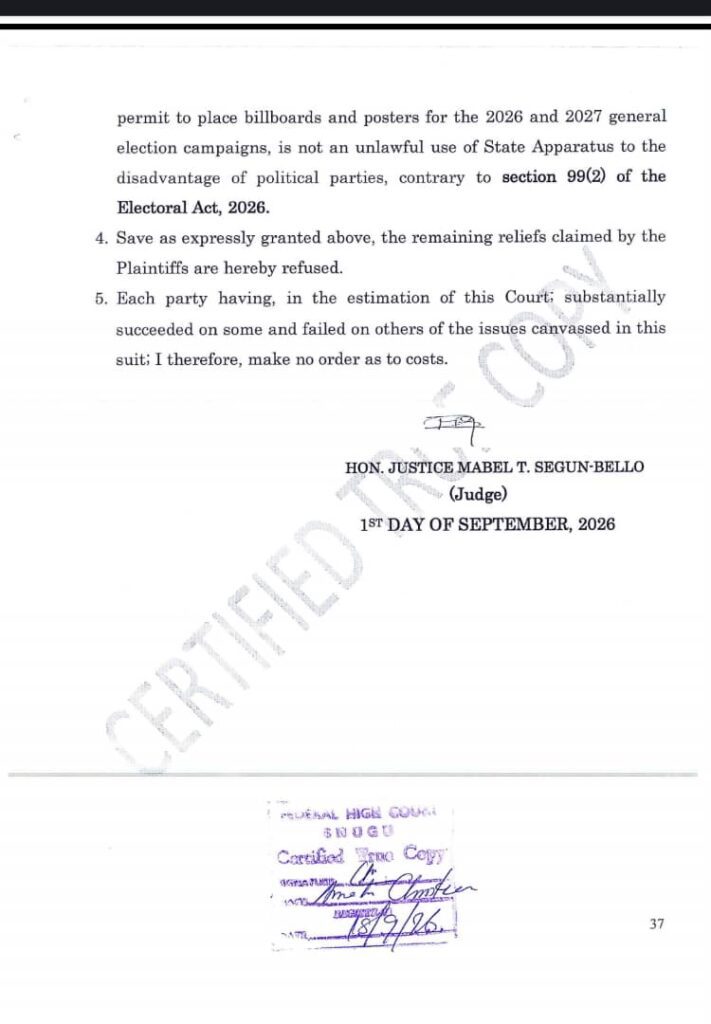
“Consequently, the directive published by the 1st and 2nd Defendants on 9th February, 2026, mandating political parties and their candidates in Enugu State to pay N150,000,000.00 (One Hundred and Fifty Million Naira) as a pre-condition for obtaining an advertising permit to place billboards and posters for the 2026 and 2027 general election campaigns, is not an unlawful use of State Apparatus to the disadvantage of political parties, contrary to Section 99(2) of the Electoral Act, 2026.

“Save as expressly granted above, the remaining reliefs claimed by the Plaintiffs are hereby refused.”

Meanwhile, the Enugu State Government says that unlike the practice in most states, the N150 million fee is for each political party, not for candidates, as misrepresented on social media and by some commentators.

The Secretary to the State Government, Prof. Chidiebere Onyia, made the clarification recently while fielding questions from Government House correspondents in Enugu, adding that there was no court judgment on the fee by any FHC in Abuja, as falsely circulated.

In a related development, finding show that the Abia State Structures for Signage and Advertising Agency (ABSSAA) prescribed feea for candidates ranging from N20 million for State House of Assembly candidates to N200 million for presidential candidates.

Imo State fees range from N3.55 million for each House of Representatives candidate to N55 million for each governorship candidate, while the permit fees range from N300,000 for local council candidates to N150 million for presidential candidates.

The campaign permit fee ranges from N100,000 for each councillorship candidate to N50 million for each presidential candidate, while Kwara State fixed its fees at N2 million for each House of Assembly candidate and N100 million for presidential candidates.

The Certified True Copy of the Court Judgement :

Continue Reading

Trending

Maduka College Advert