International
Gaza’s death toll surpasses 25,000 as ongoing Hamas war divides Israelis


The level of death, destruction and displacement from the war is without precedent in the decades-old Israeli-Palestinian conflict. Israeli officials say the fighting is likely to continue for several more months.

The conflict and the plight of hostages held in Gaza have divided Israelis and their leaders while the offensive threatens to ignite a wider war involving Iran-backed groups in Lebanon, Syria, Iraq and Yemen that support the Palestinians.
On Sunday, the Israeli Air Force carried out two series of strikes on “terrorist infrastructure,” including a military building, a launch post and an observation post belonging to the Iran-backed militant group Hezbollah, the Israeli military said. Israel said it also struck several locations in southern Lebanon, including a Hezbollah command center and military compound.
Earlier, on Saturday, at least five Iranians were killed in an Israeli strike on Damascus, Syria’s capital city, which targeted a building used by the Iranian paramilitary Revolutionary Guard, according to Syrian and Iranian officials.

And, on Thursday, Yemen-based Houthi rebels launched missiles at a merchant vessel owned by the United States, the Pentagon said, marking the latest attack from the militant group, which is similarly backed by Iran, on commercial ships in and around the Red Sea. It was the rebel group’s third strike last week targeting U.S.-owned vessels.
Violence has also spiked in the occupied West Bank. On Friday, a Palestinian-American teenager was shot and killed by Israeli troops in the West Bank, a Palestinian official told Reuters.
In Lebanon, Hezbollah forces have engaged in near-daily clashes with Israeli troops along the border.
An Israeli airstrike on Sunday hit a car near a Lebanese army checkpoint in the southern town of Kafra, killing at least one person and injuring several others, Lebanese state media reported. The identities of those killed and injured were not immediately clear. Israel’s military said it doesn’t comment on reports in foreign media.
The United States, which has provided essential diplomatic and military support for Israel’s offensive, has had limited success in persuading Israel to minimize the risk to civilians and to facilitate the delivery of more humanitarian aid.
Israeli Prime Minister Benjamin Netanyahu has rejected U.S. and international calls for postwar plans that would include a path to Palestinian statehood. U.N. Secretary-General Antonio Guterres called the refusal to accept a two-state solution “totally unacceptable.”
“The Middle East is a tinderbox. We must do all we can to prevent conflict igniting across the region,” Guterres added Sunday. “And that starts with an immediate humanitarian cease-fire to relieve the suffering in Gaza.”
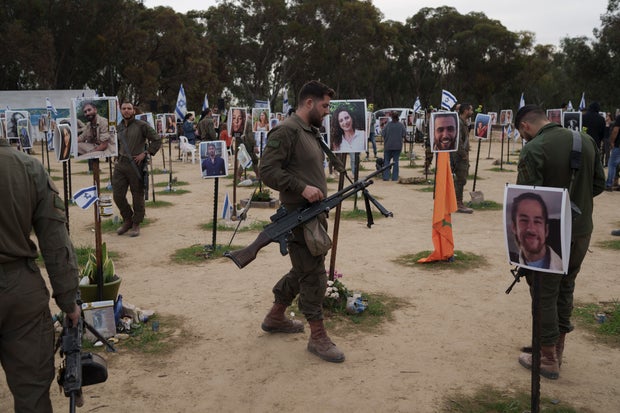
The war began with Hamas’ surprise attack in southern Israel on Oct. 7. Terrorists killed some 1,200 people, mostly civilians, and took around 250 hostages back to Gaza.
Israel responded with a bombing campaign and ground invasion that laid waste to entire neighborhoods in northern Gaza and spread south from there. Ground operations are now focused on the southern city of Khan Younis and built-up refugee camps in central Gaza dating back to the 1948 war surrounding Israel’s creation.
Israel continues to carry out airstrikes throughout the besieged territory, including areas in the south where it told civilians to seek refuge. Many Palestinians have ignored evacuation orders, saying nowhere feels safe.
Since the war started, 25,105 Palestinians have been killed in Gaza, while another 62,681 have been wounded, the Health Ministry said. The toll included the 178 bodies brought to Gaza’s hospitals since Saturday, Health Ministry spokesperson Ashraf al-Qidra said. Another 300 people were wounded in the past day, he said.
The overall toll is thought to be higher because many casualties remain buried under the rubble from Israeli strikes or in areas where medics cannot reach them, Al-Qidra said.
The Hamas-run Health Ministry does not differentiate between civilians and combatants in its figures but says around two-thirds of the people killed in Gaza were women and minors. The ministry is part of the Hamas-run government, but its casualty figures from previous wars were largely consistent with those of U.N. agencies and even the Israeli military.
The Israeli military says it has killed around 9,000 militants, without providing evidence, and blames the high civilian death toll on Hamas because it positions fighters, tunnels and other militant infrastructure in dense neighborhoods, often near homes, schools or mosques.
The military says 195 soldiers have been killed since the start of the Gaza offensive.
The war has displaced some 85% of Gaza’s residents from their homes, with hundreds of thousands packing into U.N.-run shelters and tent camps in the southern part of the tiny coastal enclave. U.N. officials say a quarter of the population of 2.3 million is starving as a trickle of humanitarian aid reaches them because of the fighting and Israeli restrictions.
“Bread does not suffice for one hour,” said Ahmad Al-Nashawi, who accepted donated food at a camp of plastic tents in the southern city of Rafah. “You can see how many children we have other than women and men. What matters most for a child is to eat.”
Netanyahu has vowed to keep up the offensive until Israel achieves “complete victory” over Hamas and returns all remaining hostages. But even some top Israeli officials have begun to acknowledge that those goals might be mutually exclusive.
Hamas is believed to be holding the captives in tunnels and using them as shields for its top leaders. Israel has managed to rescue just one hostage, and Hamas says several have been killed in Israeli airstrikes or during failed rescue operations.
A member of Israel’s War Cabinet, former army chief Gadi Eisenkot, said last week that the only way to free the hostages was through a cease-fire. In an implicit criticism of Netanyahu, he said claims to the contrary amounted to “illusions.”
Hamas has said it will not free more hostages until Israel ends its offensive. The group is expected to make any further releases conditional on securing freedom for thousands of Palestinians imprisoned in Israel, including high-profile militants involved in attacks that killed Israelis.
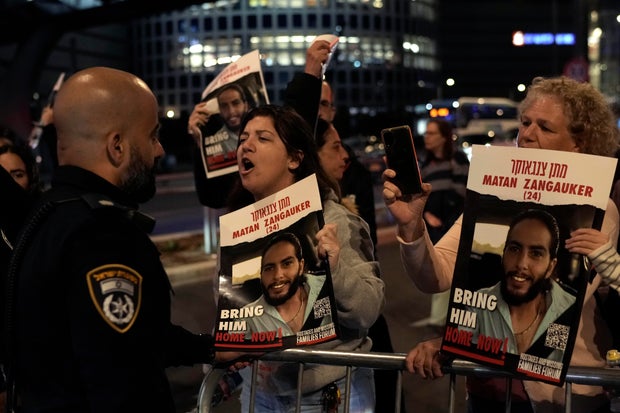
Israel’s government has ruled that out for now, but it faces growing pressure from families of the hostages, who are pushing for an exchange like the one that took place during a weeklong November cease-fire.
Some Israelis also are frustrated by the security failures that preceded the Oct. 7 attack and by Netanyahu’s handling of the war. Thousands of people gathered in Tel Aviv over the weekend to call for new elections.
But Netanyahu’s far-right coalition partners are pushing him to step up the offensive, with some calling for the “voluntary” emigration of hundreds of thousands of Palestinians from Gaza and the re-establishment of Jewish settlements there. Israel withdrew soldiers and settlers from the territory in 2005, two years before Hamas seized power from rival Palestinian forces.
CBS News














There are grave fears for the passengers of a private plane that suddenly vanished mid-flight, sparking a major search off the coast of the US.
US authorities say the Gulfstream G100 lost contact with air traffic control about 2am local time on Saturday (4pm Saturday AET) while flying from L.F. Wade International Airport in Bermuda to Boston Logan International Airport.
The US Coast Guard said the Federal Aviation Administration alerted it after contact was lost with the aircraft – which plummeted from 23,500 feet to 11,000 feet in just three minutes, according to FlightAware data.
“We are praying for a safe outcome,” a spokesperson for Latitude Air Ambulance, which operates the missing plane, told City News.
A search is now under way off Nantucket in the air and on water as crews work to locate the missing jet, the Coast Guard said. Data from FlightRadar24 showed a number of aircraft searching south of the island.
Six people are missing after a private jet vanished, sparking a major search off the coast of Nantucket in the US.
The plane was en route from Bermuda to Boston when it vanished.
“Air & surface crews have launched in search of the aircraft. Updates will be provided here as info becomes available,” the Coast Guard Northeast District said on X.
The plane was carrying out a medical evacuation in Bermuda – a British overseas territory in the north Atlantic Ocean, according to Clarence Togeretz, Director of Flight Operations at Latitude Air Ambulance.
“We always get rather concerned when our crew doesn’t report to us in a timely manner,” he told NBC News.
“But I will say that again, optimistically and positively, that doesn’t mean that the worst has happened.”
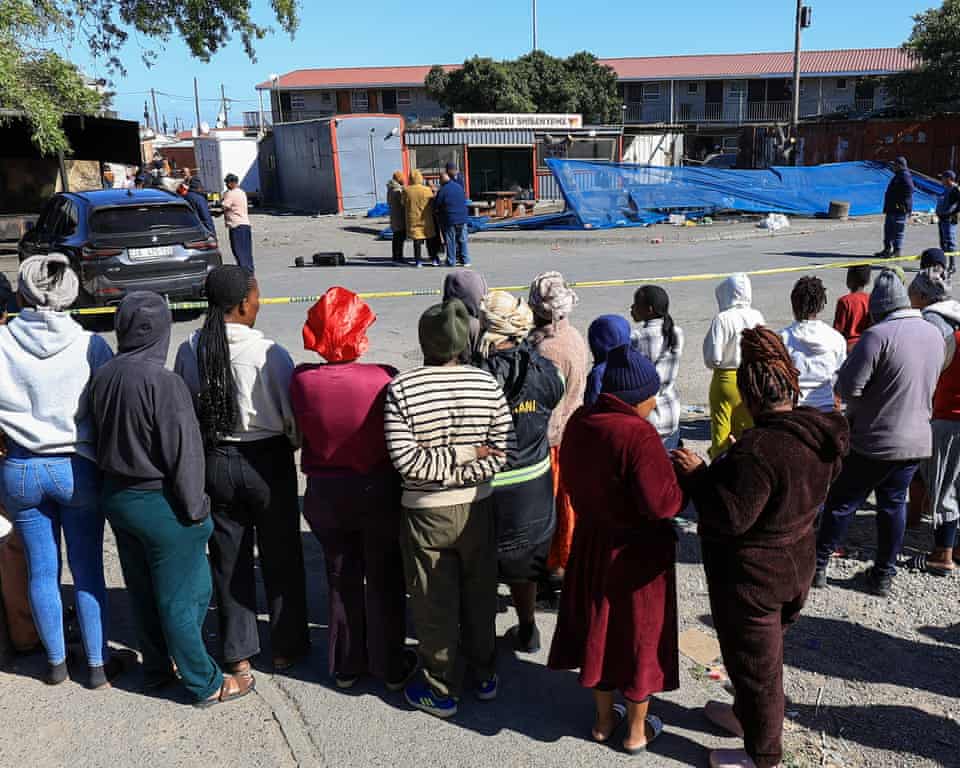
Seventeen people were killed when eight gunmen stormed a bar close to Johannesburg on Saturday evening, with 15 more injured.
In a separate shooting in the early hours of Sunday morning, 10 people were killed outside an entertainment venue in a township near Cape Town and a further 11 were injured.
South Africa has one of the highest murder rates in the world and has struggled to contain gang-related gun violence in recent years. Police have not indicated a motive for either of the latest attacks.
In Johannesburg, gunmen opened fire on customers outside the bar before continuing the attack inside and torching two vehicles before fleeing.
Police said thirteen men and four women were killed.
Deputy provincial police commissioner Maj Gen Fred Kekana said the attack may have been a retaliation for an incident last month, in which one person was killed and another wounded, according to AFP news agency.
Speaking at the scene, he said police had clear pictures and in some cases names for the suspects.
In Cape Town, five victims died at the scene and a further five people died in hospital.
No arrests had been made in either case on Sunday morning.
The two mass shootings came days after 11 people were killed in the city of Duban when gunmen stormed a house in the KwaMakhutha township.

Illegal weapons are prevalent in South Africa and gun violence has been a persistent problem for decades, with about 60 murders recorded every day in the country of 62 million.
But a recent spate of mass shootings has raised fears that the problem is deepening, with violence often linked to turf wars between gangs engaged in drug trafficking and illegal mining.
In February, President Cyril Ramaphosa called organised crime “the most immediate threat to our democracy, our society and our economic development”.
Earlier this year the military was deployed alongside police in areas with the highest murder rates in an effort to reduce armed violence.
On Saturday a tenth woman’s body was found in Ekurhuleni, to the east of Johannesburg, with local police saying they were unable to rule out a serial killer operating in the area with similarities between the deaths. (BBC)

The United States has deported more than 25,000 people under secretive agreements with 35 countries to take migrants with no ties to those nations, according to an investigation published Monday.
Since US President Donald Trump took office in January 2025, Washington has been signing deals with developing countries to take migrants who cannot legally be sent home.
The investigation by Forbidden Stories found the administration has earmarked $410 million to be paid directly to the receiving countries, or to UN agencies to facilitate the returns.
At least 25,447 people had already been deported to third countries by August 31, 2026, according to data compiled by Forbidden Stories with a consortium of international journalists.
The vast majority — around 20,000 — were sent to Mexico, but the rest were dispersed to 27 other countries across Latin America, Africa, and the Pacific, and agreements have been finalised with seven more.
The deals vary, including over which nationalities can be deported and whether people with criminal records can be accepted.
An AFP investigation earlier this year found Washington is using visa bans and restrictions on African countries to strongarm them into accepting deportees.
Lawyers told AFP that deportees were being thrown into a “legal black hole”, held without charge in countries where they have no ties and few if any rights.
Forbidden Stories said 49 of Africa’s 54 countries had been approached about accepting third-country deportees.
A little-known State Department division called the Office of Remigration, created in May 2025, has handled most of the negotiations and payments, according to Forbidden Stories.
The office is headed by Christian Jove Ehrhardt, a 41-year-old diplomat who previously worked as a security officer.
The report details his visits to Cameroon, which signed a memorandum of understanding with the US in December on accepting deportees. A week later, it also signed a five-year health assistance programme worth nearly $400 million.
The following month, the State Department said it would provide a further $30 million to the UN Refugee Agency (UNHCR) in Cameroon to “facilitate the voluntary return of refugees and combat illegal immigration.”
The first plane carrying deportees arrived in Cameroon on January 14.
– Payments –
Other agreements have involved direct payments to governments.
Palau, a small Pacific island nation with a population of under 18,000, signed an agreement in December 2025 to accept up to 75 third-country nationals in return for $7.5 million.
However, only three people have so far been sent under the agreement.
In Eswatini, 32 people have arrived since July 2025 out of a possible 160 under an agreement worth more than $5 million. It has accepted deportees with criminal records, the investigation found.
Of the $410 million planned for the agreements, internal State Department records showed that $81 million was earmarked for signatory governments.
The rest was intended for aid organisations, including more than $178 million for the UN’s International Organisation for Migration, and $123 million for UNHCR.
The agencies have faced criticism over their involvement, although UNHCR told Forbidden Stories that it was not party to the bilateral agreements and that US funding was being used in line with its mandate to strengthen asylum systems.
An IOM spokesperson told Forbidden Stories that the agency’s decisions to accept funding rested “on a single question: whether our engagement will improve the lives of the migrants affected. In these instances, we believe strongly it does.”
-
 Entertainment2 days ago
BREAKING: Temi Nkem wins BBNaija season 11
-
News1 day ago
NAF confirms ownership, launches rescue operation after aircraft crash in Ondo
-
News1 day ago
Bandits allegedly kidnap 18 Oyo students, kill driver
-
News1 day ago
NAF aircraft crashed with 32 passengers, crew – Keyamo
-

 International2 days ago
Six people missing as plane vanishes from Bermuda to Boston
-
News2 days ago
Kidnappers torture 20 corps members, demand N5m each NYSC
-
News1 day ago
Kidnappers torture 20 corps members, reduce ransom to N100m — Relatives
-
News15 hours ago
“Stop chasing shadows” – Obi’s camp fires back at Soludo over anti-Obi campaign