Connect with us

Business

Shoprite announces decision to close store in January 2024

Published

on

Spread the love

Shoprite, one of Nigeria’s leading grocery chains, will close its single outlet in Kano state, located at Kano’s famed Ado Bayero Mall, in January 2024.

The supermarket’s closing was notified in a letter to its staff on December 7, 2023.

Shoprite, which is owned by Retail Supermarkets Nigeria Limited, indicated in a letter signed by one of its officials, Mubertus Rick, that the decision was made “after careful evaluation of the store’s financial situation and the current business climate.”

The “Ado Bayero Mall Closing Announcement” letter said that the retail outlet will close on January 14, 2024.

Shoprite store

Maduka College Advert

“Dear Employees, I regret to inform you that our store in Ado Bayero Mall Kano, Kano state will be closing its doors on January 14, 2024.

“This decision was not made lightly, as we understand the impact it may have on our employees and community, however, after careful evaluation of the financial situation of the store and the current business climate we believe in the best course of action for the long term growth of our organisation,” the letter read.

“We understand that this news may be difficult to digest and we want to assure you that we are here to support you during this transitional period. Your well being is our top priority and we will do everything we can to assist you in finding new opportunities within our company,” it added.

However, the company urged its staff members to explore opportunities in its other stores across Nigeria.

“We encourage you to apply for any existing positions in our existing stores across the country, through the human resources department. Additionally, we will be opening new stores in the coming month and you are welcome to apply for employment there as well.

“We deeply appreciate your dedication, hardwork and commitment to our company through out the years.

“Your contributions have been invaluable and we area greatful that the value you have brought to our team. As we navigate this transition, we will ensure that the process is as seamless as possible for everyone involved. In the upcoming days and weeks we will provide you with more information regarding surveillance packages and other important details.

“Once again, we want to express our gratitude for your contributions to ours company’s successes. We hope that you will stay connected with us as we move forward. If you have any questions or require assistance, please don’t hesitate to reach out to me chief operating officer, or our head of human resources,” the letter concluded.

Efforts to reach the Shoprite management for comments were unsuccessful, but some business operators at the Ado Bayero Mall confirmed that the store would close in January.

“Yes, Shoprite will be shutting down its operations in Kano in January. But other businesses around the store are still operating,” an owner of a barbing Saloon in the mall told our reporter.

He declined to be identified.

The news comes just days after a number of global corporations, including pharmaceutical behemoth GlaxoSmithKline (GSK) and prominent consumer goods company Procter & Gamble (P&G), announced the closing of their Nigerian operations.

GSK and P&G had been present in Nigeria for 51 and 30 years, respectively.

In their comments, the companies blamed Nigeria’s unfavorable business environment, which had resulted in massive losses due to the country’s protracted currency crisis.

Business

Dollar to Naira exchange rate today, September 23, 2026

Published

on

Naira rebounds to 1,275/$ at parallel market
Spread the love
The Nigerian naira is trading at different rates against the United States dollar across the official Nigerian Foreign Exchange Market (NFEM) and the parallel market on Wednesday, September 23, 2026.

The latest available data show that the naira strengthened to N1,327.78 per dollar at the NFEM on Tuesday, from N1,329.80 recorded on Monday.

The latest movement represents a N2.02 appreciation by the naira against the dollar on a day-to-day basis.

In the parallel market, the dollar was quoted at about N1,389 on Tuesday, down from N1,390 recorded the previous day.

The parallel-market rate puts the gap between the official NFEM rate and the street-market selling rate at about N61.22 per dollar.

At the parallel market rate of N1,389, customers buying $100 would need approximately N138,900, while $1,000 would cost about N1.389 million.

Maduka College Advert

The exchange rate available to individuals and businesses may vary depending on the dealer, location, transaction size and prevailing market conditions.

The naira’s recent performance has come amid developments in Nigeria’s foreign exchange market, including changes in dollar liquidity and monetary policy.

The Central Bank of Nigeria has continued to monitor conditions in the foreign exchange market as the naira trades around the N1,300-per-dollar level at the official market. Reuters also reported in September that the naira had remained relatively stable, supported by central bank dollar sales and subdued import demand.

For Wednesday, September 23, the latest confirmed figures put the dollar at N1,327.78 at the NFEM and around N1,389 in the parallel market.

The rates could change during the day as demand and supply conditions shift across both markets.

Continue Reading

Business

Enugu Air Launches New Website

Published

on

Spread the love

…moves online services to www.enuguairlines.ng

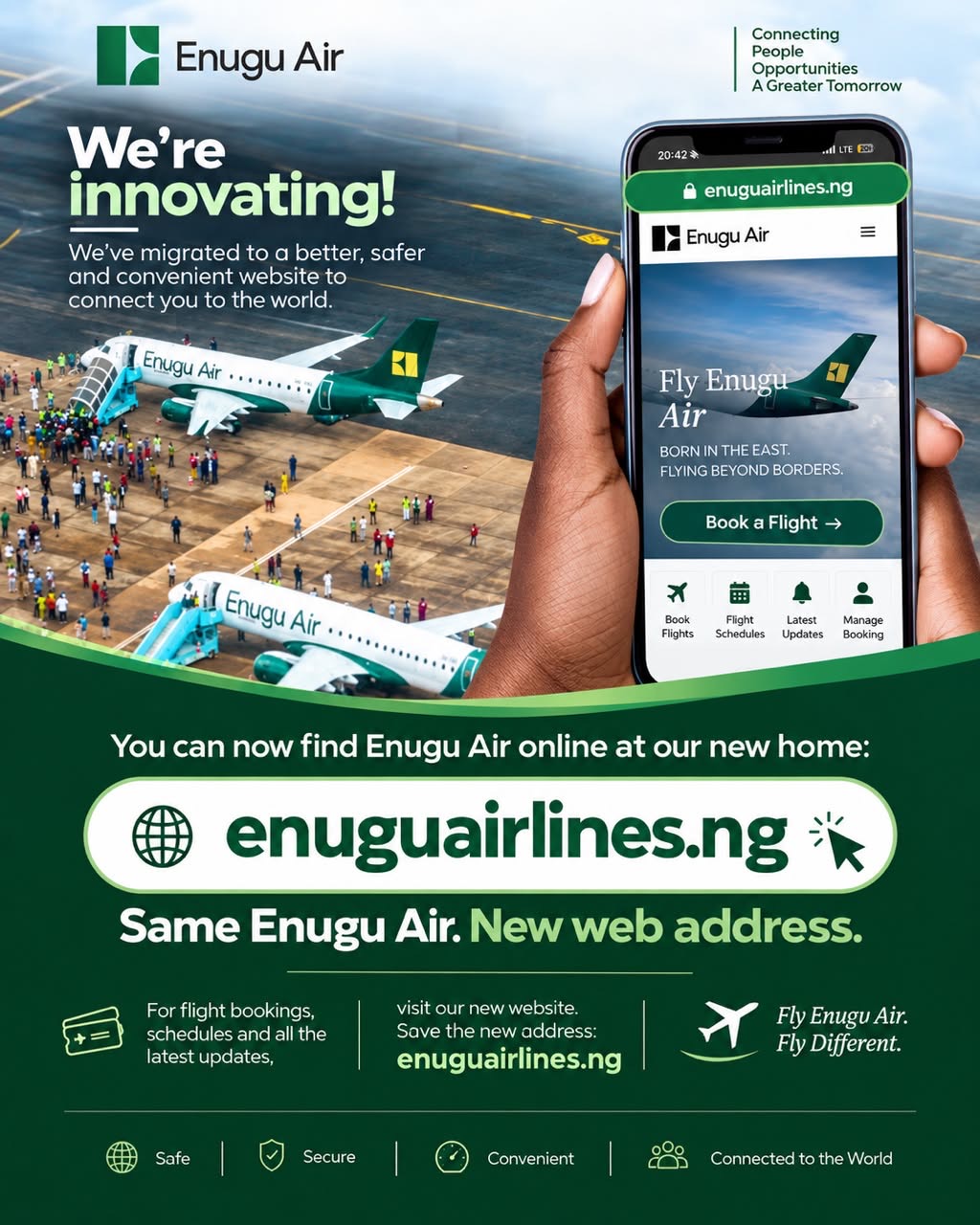
Enugu Air has announced the launch of its new official website, enuguairlines.ng, as part of efforts to provide passengers and customers with a better, safer and more convenient digital experience.

The airline said the migration to the new website is designed to improve how passengers connect with Enugu Air and access its services online, including flight bookings, schedules and the latest updates.

Announcing the development, the airline said: “We’ve moved! We’re innovating! We’ve migrated to a better, safer and convenient website to connect you to the world.”

Passengers can now access Enugu Air’s online services through its new web address, enuguairlines.ng, which the airline described as its new digital home.

The airline urged passengers and prospective travellers to save the new web address and use it for flight bookings, checking schedules and obtaining the latest information about its operations.

Maduka College Advert

“Same Enugu Air. New web address,” the airline stated, emphasising that the change represents an improvement in its digital platform while retaining the Enugu Air brand and services.

The airline further encouraged customers to visit, www.enuguairlines.ng for all flight-related information and online services.

It further stated that the old website, enuguairlines•com has been discarded and no longer in use.

Continue Reading

Business

Nigeria records 8.51m terabytes of data use in first half of 2026

Published

on

Nigerian Communications Commission
Spread the love

Nigerians consumed a record 8.51 million terabytes of data in the first half of 2026, underscoring the country’s accelerating shift toward a digital-first economy.

Data from the Nigerian Communications Commission (NCC) confirmed this. Specifically, in January, consumption was 1.385 million terabytes; February, 1.260 million terabytes and March, 1.422 million terabytes.

In April, consumption was 1.414 million terabytes. It climbed to 1.504 million terabytes in May and 1.532 million terabytes in June.

In 2025 alone, Nigerians consumed over 13.2 million terabytes of data, a 35 per cent increase from 2024, reflecting how connectivity has become essential for daily life.

The surge in consumption was driven largely by the twin giants of the telecom sector, MTN Nigeria and Airtel Nigeria, whose half-year reports revealed data services have firmly overtaken voice as the primary revenue stream.

Maduka College Advert

According to industry figures, average monthly data usage per subscriber rose sharply, reflecting the growing reliance on mobile broadband for work, entertainment, and commerce.

Streaming platforms, social media, fintech apps, and remote work tools have all contributed to the spike in demand.

MTN Nigeria reported that its 55.7 million active data subscribers consumed an average of 14.8 gigabytes per month, representing a 15.2 per cent increase year-on-year. Overall, MTN’s data traffic surged by 25.8 per cent across its network in the period.

This translated into a massive N1.70 trillion in data revenue, a 38.4 per cent jump compared to the same period in 2025. Data now accounts for more than half of MTN’s total service revenue, dwarfing its voice earnings of N993.5 billion, which grew at a modest 12 per cent.

Airtel Nigeria also posted strong numbers, recording N691 billion in data revenue ($507 million). While Airtel’s voice services contributed to a combined N1.42 trillion in voice earnings alongside MTN, the clear trend is that data has become the dominant driver of growth.

Together, MTN and Airtel generated N2.4 trillion from data services in H1 2026, cementing their role as the backbone of Nigeria’s digital economy.

MTN invested N620.5 billion in capital expenditure during the period, focusing on expanding 4G coverage, scaling 5G rollout, and strengthening fibre infrastructure. The company’s aggressive push into next-generation networks is aimed at meeting the surging demand for high-speed connectivity.

Airtel, meanwhile, faced challenges with fibre cuts and vandalism, forcing reinvestments to stabilize its network. The operator is blending 5G expansion with satellite partnerships to extend coverage into rural and semi-urban areas, where demand for reliable Internet is rising.

Despite these investments, many consumers continue to express dissatisfaction with service quality. Complaints of slow speeds, unstable connections, and high costs remain widespread, highlighting the gap between consumption growth and infrastructure capacity.

The NCC has repeatedly urged operators to deepen investments in fibre, towers, and spectrum to sustain the country’s digital transformation. Analysts note that the sector is undergoing a structural shift from voice-first to data-led growth, with internet connectivity now central to economic activity.

Industry experts predict that Nigeria’s data consumption will continue to rise exponentially as smartphone penetration increases and more services migrate online. The rollout of 5G is expected to further accelerate usage, enabling innovations in fintech, e-commerce, healthtech, and entertainment.

The consumption of 8.51 million terabytes in H1 2026 marks a historic high for Nigeria’s telecom industry. It reflects not only the appetite of a digitally hungry population but also the broader transformation of the economy.

With MTN and Airtel leading the charge, the challenge now lies in improving service quality, expanding infrastructure, and ensuring affordable access for millions of Nigerians. As data becomes the lifeblood of communication and commerce, the telecom sector’s ability to keep pace with demand will determine how effectively Nigeria harnesses the opportunities of the digital age.


Continue Reading

Trending

Maduka College Advert