International
Liz Truss to be Britain’s new prime minister, replacing Boris Johnson

- Liz Truss beat Rishi Sunak to become Britain’s new prime minister
- Boris Johnson resigned as prime minister in July
Britain will get its third prime minister in just over three years as the ruling Conservative Party announced Monday it had chosen Liz Truss to be its new leader after an internal party contest.
Truss replaces Boris Johnson, a controversial maverick who defied many of Britain’s political traditions. Johnson resigned in July after senior members of his government turned against him amid a series of scandals connected to breaking his own coronavirus lockdown rules and waning appetite for his brand of populist politics . Because Britain elects a party, not a specific leader, the party in power has some scope to swap in a new prime minister. Truss was selected by about 172,000 grassroots members of the Conservative Party. That figure represents less than 1% of the U.K.’s 67 million population.

The new prime minister takes office Tuesday and assumes power as household energy bills in the U.K. soar to unaffordable levels for millions of people.
In a brief speech, Truss thanked Johnson.
“Boris, you got Brexit done. You crushed Jeremy Corbyn, you rolled out the vaccine. And you stood up to Vladimir Putin. You were admired from Kyiv to Carlisle.”

Truss won 81,326 votes to Sunak’s 60,399, or 57% to 43%.
Truss, 47, has sought to portray herself as the political heir to Margaret Thatcher, Britain’s “Iron Lady” and first female leader who advocated with zeal for free markets, lower taxes and the privatization of large state enterprises from telecoms to energy. Truss served in Johnson’s government, first as a trade minister and then as foreign secretary. She has taken a hardline stance on Russia over its invasion of Ukraine.
“The thread that runs through Truss’s career is a belief in small government,” Daniel Hannan, a former Conservative party politician, wrote in an opinion piece published on his website. Hannan is now known as Lord Hannan of Kingsclere in the House of Lords, the unelected upper House of Parliament to which he was appointed by Johnson.
Sunak, 42, served in Johnson’s government as finance minister, where he oversaw a multi-billion dollar coronavirus support package for businesses and workers. His campaign struggled to shake off the perception, anathema to Conservative political ideology, that he presided over a big state intervention during the coronavirus pandemic. It was aimed at warding off mass unemployment and an economic depression.
Political experts say Britain’s new leader is unlikely to usher in major changes to the U.K.’s foreign policy that would upend its close relationship with the White House. But one possible flashpoint that Truss inherits from Johnson is what to do with the border between Northern Ireland, part of the U.K., and Ireland, part of the European Union, as a result of the U.K.’s departure from the European Union, known as Brexit.
This previously open border is now subject to checks on some goods and services and Conservatives want to change the customs and immigrations rules at the risk, say U.S. and European officials, of damaging the fragile peace that’s existed in Northern Ireland since the U.S.-brokered Good Friday Agreement took effect in1998.
“Truss is a full-throated Atlanticist, as is Sunak, who thinks that the U.K. is the keystone NATO partner,” said Matt Beech, director of the Center for British Politics, University of Hull, England, referring to close U.S.-U.K. security cooperation.
The first order of business for Truss will be to reassure the British public that she has a plan to deal with rapidly increasing energy costs and an inflationary spiral caused by the lingering coronavirus pandemic, Russia’s unprovoked war in Ukraine and Britain’s almost two-year-old exit from the EU bloc. All three events have disrupted supply chains and led to higher consumer costs.
The U.K. uses little oil and gas supplied by Russia, but by next month the typical British household is expected to pay around $4,200 a year to heat and power a home, according to Ofgem, Britain’s energy regulator. That’s an 80% annual rise and reflects the way the British government has engineered its energy market to be reliant on wholesale prices, which have skyrocketed amid the war in Ukraine.
Forecasts suggest U.K. energy bills could reach more than $7,700 early next year, more than many U.K. residents pay for rent or a mortgage and threatening to trigger so-called fuel poverty for millions and force many small businesses to close.
“Unless the government steps in there will be a social catastrophe,” independent personal finance expert Martin Lewis told a BBC radio program recently.
“How (Truss) reacts to the energy crisis will not only have a direct impact on the lives of U.K. citizens and the survival of many businesses, but also affect perception of the competence of the administration,” said Antony Froggatt, an environmental policy expert at Chatham House, a London-based think tank.
“It is a baptism by fire.”
As part of the hand over of power, Queen Elizabeth will receive Johnson and Truss at Balmoral, her estate in Scotland, on Tuesday, Buckingham Palace said.
It is a break from tradition. Normally the queen would host the departing and new British leaders at her London residence, which she has done 15 times before during her 70-year reign. In recent months the monarch, 96, has participated in fewer royal duties. (USA TODAY)



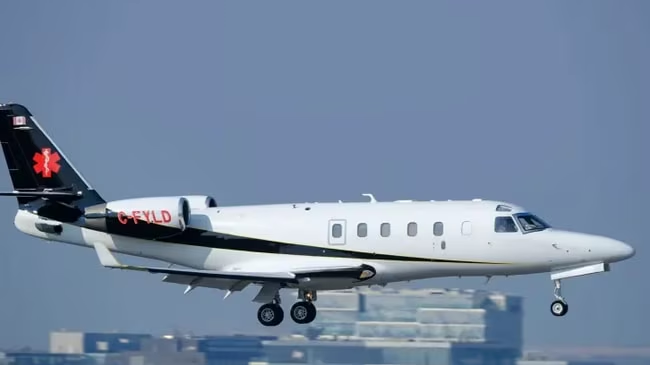
There are grave fears for the passengers of a private plane that suddenly vanished mid-flight, sparking a major search off the coast of the US.
US authorities say the Gulfstream G100 lost contact with air traffic control about 2am local time on Saturday (4pm Saturday AET) while flying from L.F. Wade International Airport in Bermuda to Boston Logan International Airport.
The US Coast Guard said the Federal Aviation Administration alerted it after contact was lost with the aircraft – which plummeted from 23,500 feet to 11,000 feet in just three minutes, according to FlightAware data.
“We are praying for a safe outcome,” a spokesperson for Latitude Air Ambulance, which operates the missing plane, told City News.
A search is now under way off Nantucket in the air and on water as crews work to locate the missing jet, the Coast Guard said. Data from FlightRadar24 showed a number of aircraft searching south of the island.
Six people are missing after a private jet vanished, sparking a major search off the coast of Nantucket in the US.
The plane was en route from Bermuda to Boston when it vanished.
“Air & surface crews have launched in search of the aircraft. Updates will be provided here as info becomes available,” the Coast Guard Northeast District said on X.
The plane was carrying out a medical evacuation in Bermuda – a British overseas territory in the north Atlantic Ocean, according to Clarence Togeretz, Director of Flight Operations at Latitude Air Ambulance.
“We always get rather concerned when our crew doesn’t report to us in a timely manner,” he told NBC News.
“But I will say that again, optimistically and positively, that doesn’t mean that the worst has happened.”
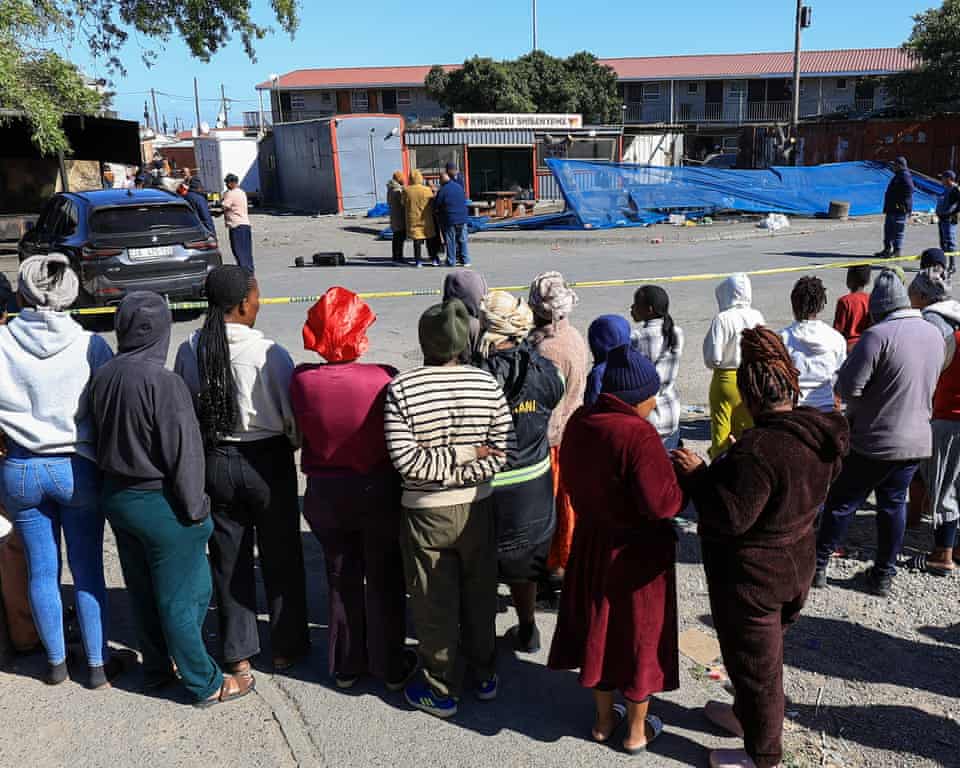
Seventeen people were killed when eight gunmen stormed a bar close to Johannesburg on Saturday evening, with 15 more injured.
In a separate shooting in the early hours of Sunday morning, 10 people were killed outside an entertainment venue in a township near Cape Town and a further 11 were injured.
South Africa has one of the highest murder rates in the world and has struggled to contain gang-related gun violence in recent years. Police have not indicated a motive for either of the latest attacks.
In Johannesburg, gunmen opened fire on customers outside the bar before continuing the attack inside and torching two vehicles before fleeing.
Police said thirteen men and four women were killed.
Deputy provincial police commissioner Maj Gen Fred Kekana said the attack may have been a retaliation for an incident last month, in which one person was killed and another wounded, according to AFP news agency.
Speaking at the scene, he said police had clear pictures and in some cases names for the suspects.
In Cape Town, five victims died at the scene and a further five people died in hospital.
No arrests had been made in either case on Sunday morning.
The two mass shootings came days after 11 people were killed in the city of Duban when gunmen stormed a house in the KwaMakhutha township.

Illegal weapons are prevalent in South Africa and gun violence has been a persistent problem for decades, with about 60 murders recorded every day in the country of 62 million.
But a recent spate of mass shootings has raised fears that the problem is deepening, with violence often linked to turf wars between gangs engaged in drug trafficking and illegal mining.
In February, President Cyril Ramaphosa called organised crime “the most immediate threat to our democracy, our society and our economic development”.
Earlier this year the military was deployed alongside police in areas with the highest murder rates in an effort to reduce armed violence.
On Saturday a tenth woman’s body was found in Ekurhuleni, to the east of Johannesburg, with local police saying they were unable to rule out a serial killer operating in the area with similarities between the deaths. (BBC)
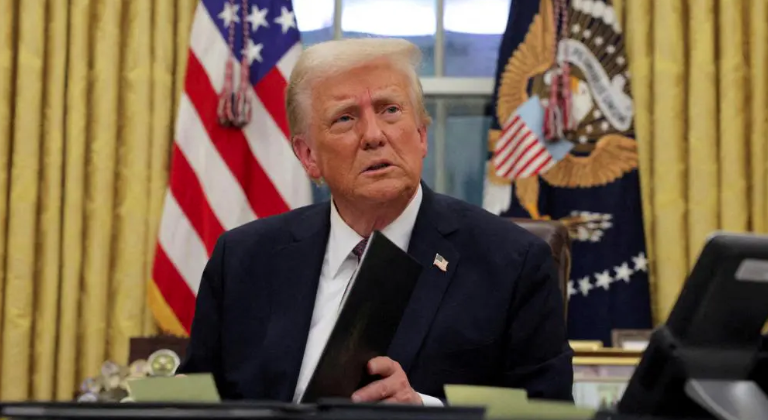
The United States has deported more than 25,000 people under secretive agreements with 35 countries to take migrants with no ties to those nations, according to an investigation published Monday.
Since US President Donald Trump took office in January 2025, Washington has been signing deals with developing countries to take migrants who cannot legally be sent home.
The investigation by Forbidden Stories found the administration has earmarked $410 million to be paid directly to the receiving countries, or to UN agencies to facilitate the returns.
At least 25,447 people had already been deported to third countries by August 31, 2026, according to data compiled by Forbidden Stories with a consortium of international journalists.
The vast majority — around 20,000 — were sent to Mexico, but the rest were dispersed to 27 other countries across Latin America, Africa, and the Pacific, and agreements have been finalised with seven more.
The deals vary, including over which nationalities can be deported and whether people with criminal records can be accepted.
An AFP investigation earlier this year found Washington is using visa bans and restrictions on African countries to strongarm them into accepting deportees.
Lawyers told AFP that deportees were being thrown into a “legal black hole”, held without charge in countries where they have no ties and few if any rights.
Forbidden Stories said 49 of Africa’s 54 countries had been approached about accepting third-country deportees.
A little-known State Department division called the Office of Remigration, created in May 2025, has handled most of the negotiations and payments, according to Forbidden Stories.
The office is headed by Christian Jove Ehrhardt, a 41-year-old diplomat who previously worked as a security officer.
The report details his visits to Cameroon, which signed a memorandum of understanding with the US in December on accepting deportees. A week later, it also signed a five-year health assistance programme worth nearly $400 million.
The following month, the State Department said it would provide a further $30 million to the UN Refugee Agency (UNHCR) in Cameroon to “facilitate the voluntary return of refugees and combat illegal immigration.”
The first plane carrying deportees arrived in Cameroon on January 14.
– Payments –
Other agreements have involved direct payments to governments.
Palau, a small Pacific island nation with a population of under 18,000, signed an agreement in December 2025 to accept up to 75 third-country nationals in return for $7.5 million.
However, only three people have so far been sent under the agreement.
In Eswatini, 32 people have arrived since July 2025 out of a possible 160 under an agreement worth more than $5 million. It has accepted deportees with criminal records, the investigation found.
Of the $410 million planned for the agreements, internal State Department records showed that $81 million was earmarked for signatory governments.
The rest was intended for aid organisations, including more than $178 million for the UN’s International Organisation for Migration, and $123 million for UNHCR.
The agencies have faced criticism over their involvement, although UNHCR told Forbidden Stories that it was not party to the bilateral agreements and that US funding was being used in line with its mandate to strengthen asylum systems.
An IOM spokesperson told Forbidden Stories that the agency’s decisions to accept funding rested “on a single question: whether our engagement will improve the lives of the migrants affected. In these instances, we believe strongly it does.”
-
 Entertainment2 days ago
BREAKING: Temi Nkem wins BBNaija season 11
-
News1 day ago
NAF confirms ownership, launches rescue operation after aircraft crash in Ondo
-
News1 day ago
Bandits allegedly kidnap 18 Oyo students, kill driver
-
News1 day ago
NAF aircraft crashed with 32 passengers, crew – Keyamo
-

 International2 days ago
Six people missing as plane vanishes from Bermuda to Boston
-
News2 days ago
Kidnappers torture 20 corps members, demand N5m each NYSC
-
News1 day ago
Kidnappers torture 20 corps members, reduce ransom to N100m — Relatives
-
News16 hours ago
“Stop chasing shadows” – Obi’s camp fires back at Soludo over anti-Obi campaign